


Page 97 - NAVAL SCIENCE 3 TEXTBOOK
P. 97
102     NAVAL  l.:NOWLEDGE

                                                               fore, may not adopt (111)' means to intlkt injury 011  the enemy. Rules
                                                               exist so belligerents do not eSCillate a contlic! to  total war, with all
                                                               of its devastating implic.ltions.
                                                                  The limitation on land and naval \\',lrfare ilre, in general, simi-
                                                               lar. The first group of restrictions concerns the conduct of the war
                                                               itself-for example, prohibitions  on  the  use  of certain  weapons
                                                               such as poisons, poison gases, and "dumdum" bullets. The second
                                                               group protects persons who are not involved in the actual conduct
                                                               of the  W,ll":  civilians, sick  .1l1d  wounded  members of the  armed
                                                               forces, and prisoners of Will'.
                                                                  The  three  basic  principles  underlying  the  rules  of civilized
                                                               \\'art~lre  have  historically  been  humanity.  chivalry,  and  1l1ilitary
                                                               necessity. Of these, humanity is  unquestionably the most  impor-
                                                               tant.  It  is  the basis  for  all  prohibitions  imposed  by  international
                                                               law on belligerents for the purpose of limiting excessive  violence.
                                                               Chi"illry involves the qualities of bravery, honor, courtesy, respect
                                                               for women, protection of the weak, generosity, and t~lirness to ene~
                                                               mies. The principle of nl.ilit,l1'Y  necessity  permits a belligerent to
                                                               apply only the degree and kind of regubted  force  not otherwise
                                                               prohibited by the laws of war. The rules of international law come
                                                               above military necessity, because the latter does not constitute an
                                                               .lCceptable defense for lawlessness in the conduct of war.


                                                               War at Sea
                                                               The  major distinction  between  land  W<lrt~He and war  at  sea  lies
                                                               in  the fact  that land warfare takes place primarily all the territory
                                                               of one or se\'Cral of the  belligerents,  while  sea  warl~He is  mostly
                                                               fought all the high seas. These high seas are not within the sover-
                                                               eignty of either belligerent but are open to hlwfuluse by illl  nations
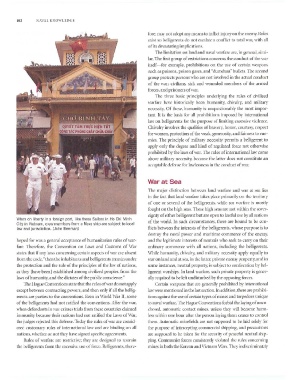
        When  on  liberty in  a foreign  port,  like these Sailors in  Ho Chi  Minh   of the world.  In  sllch  circlllllstances, there are bound to be con-
        City  in  Vietnam,  crew members from  a Navy ship are  subject to  local
        law and  jurisdiction. (John  Beeman)                  tlicts between the interests of the belligerents, whose purpose is to
                                                               destroy  the  naval  power and  maritime commerce of the  enem)',
        hoped for was a general acceptance of Illllllanit<lrian  rules of war-  and the legitimate interests of neutrals who seek to carryon their
        fare.  Therefore,  the  Convention  on  Laws  ilnd  CUStOlllS  of \.\r ar   ordinary  commerce  with  all  nations,  including  the  belligerents.
        states that if any laws concerning certain aspects of war arc clbscnt   \Vhile humanity, chivalry, and  military neccssit}' ilPpJy  equally to
        from the code, "then the inhabitants and belligerents reI1lilin under   war on land and at sea, in the latter, private enem), property, and in
        the protection and the rule of the principles of the hlW of n<1tions,   some instances, neutral propert)', is subject to confiscillion by bel-
        as  they  [have been]  established among civilized peoples, from  the   ligerent  warships. In land \\'art~ue, such  private propert)' is gener-
        laws of humanity, cllld the dictates of the public conscience,"   all)' required to be len undisturbed b)' the opposing forces.
           The Hague Conventions state that the rules of war do not apply   Certain weapons that arc generilily prohibited by  international
        except between contracting powers, and then only if all  the bellig-  law were mentioned in the last section. in addition, there are prohibi-
        erents are parties to  the conventions. Even  in \Vorld \Var  II, some   tions against the use of certain types of mines and torpedoes unique
        of the belligerents had  not ratified the conventions. After the war,   to naval wart~lre. The Hague Conventions forbid the laying of unan-
        when defendants in war crimes trials from these countries claimed   chored,  automatic  contact  mines, unless  they will  become  harm-
        imlllunity because their nations had not ratified the Laws of '"Val',   less within one hour after the person laying them ccases to control
        the judges rejected this defense. Today the rules of W,ll" are consid-  them. Autolllatic  minefields are not supposed  to  be laid  solely for
        ered  customary rules  of international law  and are binding on all   the purpose of intercepting cOlllmercial shipping, and  preCillitiollS
        nations, whether or not they h'1\'e signed specific agreements.   are supposed  to  be taken  for  the security of peaceful neutral ship-
           Rules  of wclrl~lre are  restrictive;  they are  designed  to  restrain   ping. Communist forces  consistently violated  the rules concerning
        the belligerents from  the excessive use of force.  Belligerents, there-  mines in both the Kore'lI1 and Vietnam \·Vars. They indiscriminately

