


Page 93 - NAVAL SCIENCE 3 TEXTBOOK
P. 93
98       NAVAL  KKOW I.EDGE

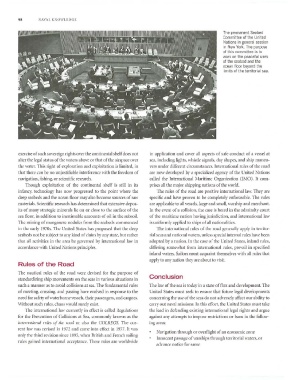
                                                                                               The  permanent  Seabed
                                                                                               Committee of the United
                                                                                               Nations in general  session
                                                                                               in New York. The purpose
                                                                                               of this committee is to
                                                                                               work on the peaceful uses
                                                                                               of the seabed  and  the
                                                                                               ocean floor beyond  the
                                                                                               limits of the territorial sea.


         exercise of sllch sovereign rights over the continental shelf does not   in application nnd cover aU  aspects of safe conduct of a vessel  at
         alter the legal status of the waters abo\'e or that of the airspace over   sea, including lights, whistle signals, day shapes, and ship maneu-
         the wilter. This right of exploration ilnd exploitation is limited, in   \'ers under different circumstances. International rules of the road
         that there can be no unjustifiable interference with the freedom of   arc  now developed by a specialized agency of the United Nations
         navigation, fishing, or scientific research.           called  the International Jvlaritimc Organization  (IMO).  It com-
            Though  exploitation  of  the  continental  shelf  is  still  in  its   prises all  the major shipping nations of the world.
         infancy.  technology  has now  progressed  to  the point  where  the   The rules of the road are  positive  international law.  They are
         deep seabeds and  the ocean floor may also become sources of raw   specific  and have  proven to be completely enforceable.  The  rules
         materials. Scientific research has determined that extensive depos-  are applicable to all vessels, large and small, warship and merchant.
         its of many strategic minerals lie on or d ose to the surface of the   In  the event of a collision, the case is heard  in  the admiralty court
         sea floor, in addition to inestimable amoullts of oil in the subsoil.   of the maritime  nation having jurisdiction, and international law
         The mining of manganese  nodules from the senbeds commenced   is uniformly applied to ships of all nationalities.
         in  the earl)'  1970s. The United States  has proposed that the deep   The international rules of the road generally ilpply in  territo-
         seabeds not be subject to any kind of claim b)' al1Y state, but rather   rial seilS ilnd national waters, unless special internal rules have been
         that all  activities  in the area be  governed  by  international law in   adopted by a nation. In the case of the United States, inland rules,
         accordance with United Nations principles.             differing somewhat from internationnl rules,  pre\'ail in specified
                                                                inland waters. Sailors must acquaint themsel\'es with all  rules that
                                                                apply to nn)' nation they are about to visit.
         Rules of the Road

         The  nautical rules  of the  road  were devised  for the purpose  of
                                                                Conclusion
         st.lIldardizing ship movements on the seilS in variolls situntions in
         sllch a manner ns to avoid collisions at sea. The fundamental rules   The law of the sea is today in a stilte of flux and development. The
         of meeting, crossing, and passing have evolved in  response to the   United States  mllst seek to ensure that future legal developments
         need for safety of waterborne vessels, their passengers, and cargoes.   concerning the lise of the seas do not adversely affect our ability to
         \ Vithout such rules, chaos would surel), exist.       carry out naval missions. In this effort, the United States must take
            The international law currently in effect is called Regulations   the lead ill  defending existing internationalleg<J1  rights and argue
         for the Prevention of Collisions at Sea, cOlllmonly  known as  the   against nny attempts to impose restrictions or bans in  the foliow-
         illtemntioll(/l  rilles  of the ro(/rl  or also  the  COLREGS.  The  Ct1l'-  ing areas:
         rent law was revised in  1972  and  came into effect in  1977.  It was
                                                                   Navig<Jtion through or overflight of an economic zone
         only the third revision since  1895, when British and french sniling
                                                                   Innocent passage of warships through territori<J1 waters, or
         rules gained international  acceptance. These rules  are worldwide
                                                                   advance notice tor same

