


Page 96 - NAVAL SCIENCE 3 TEXTBOOK
P. 96
l NTE]{N ATl ONA I.  LAW  AND  THE SEA   101

            Such  immunities do  not  me;1I1  the  ship  can  act  in  a lawless   General Rules of War on L and and Sea
         manner.  Responsibility and  leadership  are  again  the  key  to  such
                                                                Navy Regula/io/ls states, "In the event of war between nations with
         privileges.  By  accepting  the  hospitality  of the  port,  the  warship
                                                                which  the  United  States  is  at  peace,  a cOlllmander sh'lll  observe,
         collsents  to  comply  with  harbor  regulations  concerning  speed
                                                                and  require  his  command  to  observe,  the  principles of interna-
         and traffic contro\, sewage disposal, health and quaralltine restric-
                                                                tionallaw." This statement  makes it  clear that n.wal  officers must
         tiolls, and so forth.  If the ship does not meet such standards, valid
                                                                be thoroughl), knowledgeable of the rules of wariare.
         grounds exist for complaint through diplomatic channels.
                                                                   J\'lilny definitions of "",ar" exist, but for this particular discus-
            The  officers  and  crew  of a warship  arc  completely  immune
                                                                sion the simple definition  of war  as "a legal  condition  of arllled
         from 10«11 jurisdiction (authorit)') while on board the ship in a for-
                                                                hostility between  states" is  applicable.  It generally implies armed,
         eign port. Sirnilariy, it is customary for local authorities to waive all
                                                                physical  conflict between  nations, but in  the legal sense, a state of
         jurisdiction over officers or crew members ashore on official busi-
                                                                war may exist before or after the use of force.  The violence of W,1r
         ness.  However, the situation is diA-erent when officers and enlisted
                                                                existed from  7 December 1941  until the Congress I<gall)' declared
         personnel go ashore unofficially for leave or liberty. III  most COUIl-
                                                                war on Japan the next  day. The treaty of peace with Japan did  not
         tries, local law and jurisdiction will apply to the visitors. In the case
                                                                come  into  force  until  1952, even  though  all  fighting  had  ceased
         of u.s. Navy visits to allied  nations, there often exists an arrange-
                                                                on  15 August  1945 and the surrender document was signed  all 2
         ment, the Status of forces Agreement, which specifies in detail how
                                                                September.  It would seem that such  legal details would be unim-
         any problems ilre to be handled. All personnel on leave or liberty in
                                                                portant, but such  is  not  the  case.  \Var  clauses  in  insurance  poli-
         a foreign country should be well advised on the local law and what
                                                                cies,  certain  provisions of the  Uniform  Code of Military  Justice,
         to do should they get in trouble there.
                                                                and certain  presidential powers, among others, are hinged on the
            There is  a diA-erence  in  the case of merchant ships visiting a
                                                                legal state of war, not necessarily the violence of conflict.
         foreign  port. International law states that a merchant ship is sub-
                                                                   liecause of the events of the Cold \Var, it is now generally rec-
         ject  to  the jurisdiction of the nation being visited. This illustrates
                                                                ognized  that  the  rules of war  apply  in  all  armed conflicts  of an
         the fact  that a merchant ship is not considered an extension of the
                                                                international nature, regardless of whether or not war is  formally
         "territory" of the  nation  of registry, as  is a warship.  This diA-er-
                                                                declared. In other words, military and naval actions between war-
         enee  is probably best exemplified  in  the  matter of asylum  (zone
                                                                ring nations should follow  the rules of war, whether the det'1i1s of
         of absolute safety). In the case of a warship, local authorities Illay
                                                                legality are present or not. It should  be pointed out that the  1907
         110t come aboard to arrest or remove an  individual seeking asyluill
                                                                Hague Peace Conventions, in their attempts to broadly codify the
         for  political or personal safety reasons.  In  the case of a merchant
                                                                laws  of war,  first recognized  that the avoidance of war should be
         ship, however, local  police may come aboard, arrest, and  remove
                                                                attempted  as  <In  ultimate  goal  in  all  cases.  Second,  they  recog-
         an  accllsed offender. The doctrine of C1sylum, then, is not applica-
                                                                nized  that war  is sometimes  unavoidable and  has  to  be accepted
         ble to merchant ships.
                                                                as a regrettable but legitimate means of settling disputes between
                                                                nations.  Because of this,  it  was  agreed  that the best th'1t could be
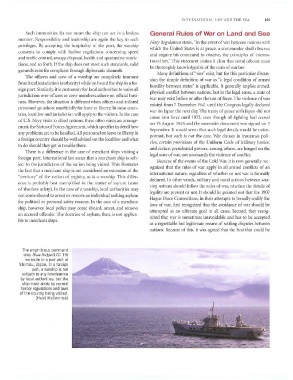
          The amphibious command
           ship  Blue Ridge (LCC  191
            en  route to a port visit at
         Shimizu, Japan.  In a foreign
              port,  a warship  is not
          subject to any interference
          by  local  authorities,  but the
          ship must abide by normal
          harbor regulations and  laws
         of the country  being visited.
                (Heidi  McCormickl

