


Page 200 - NS-2 Textbook
P. 200
MARITIME  GEOGRAPHY                                                                                   195


      north, and the Gulf of Aden to the south, the Red Sea is   are major oil producers. The gulf itself has been divided
       the main waterway between Europe and Asia. The north-  for oil drilling by these nations, since much of the oil is
      ern access is the Suez Canal. 11,e choke point in the south   gotten by offshore rigs.
       is  the  Strait  of  Bab  el  Mandeb.  (The  Arabic  word  bab   Millerals. Though oil was known to be present in the
                  U
      means Ugate or  "sh'ait.")  Less  than 20 miles ,vide, the   region since ancient days, the drilling of oil wells there is
      strait separates Yemen  on  the Arabian  Peninsula from   a fairly recent development. The first wells in Iran were
      Ethiopia and the Republic of Djibouti in Africa.        not drilled until 1935, and those in Kuwait did not start
                                                              up until 1946. World War II caused a  major increase in
          THE  PERSIAN  GULF AND GULF  OF  OMAN               drilling in both Iran and Saudi Arabia. In the past twenty
                                                              years, the wells and offshore rigs there have become very
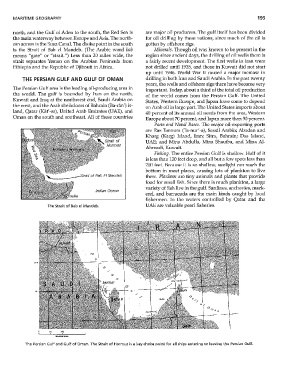
      11,e Persian Gulf area is the leading oil-producing area in   important. Today, about a third of the total oil production
       the  world.  The  gulf is bounded by Iran on the  north,   of the world comes  from  the Persian Gulf.  The United
      Kuwait and Iraq at the northwest end, Saudi Arabia on
                                                              States, Western Europe, and Japan have come to depend
       the west, and the Arab sheikdoms of Bahrain (Ba-ran') is-  on Arab oil in large part. The United States imports about
      land, Qatar (Kat'-ar), United Arab Emirates (UAE), and
                                                              40 percent of its annual oil needs from the area, Western
      Oman on the south and southeast. All of these countries
                                                              Europe about 70 percent, and Japan more than 90 percent.
                                                                 Ports alld  Naval  Bases.  The major oil-exporting ports
                                                              are Ras Tannura (Ta-nur'-a), Saudi Arabia; Abadan and
                                                              Kharg  (Karg)  Island,  Iran;  Sitra,  Bahrain;  Das  Island,
                                                              UAE;  and Mina  Abdulla, Mina Shauiba, and Mina Al-
                                                              Ahmadi, Ku\vait.
                                                                 Fishing.  The entire Persian Gulf is shallow. Half of it
                                                              is less than 120 feet deep, and all but a few spots less than
                                                              200 feet.  Because it is so shallow, sunlight can reach the
                                                              bottom in most places, causing lots of plankton to live
                     "'-___ ---"[ral[ of Bab E/  Mandeb       there. Plallktoll are tiny animals and plants that provide
                                                              food for small fish. Since there is much plankton, a large
                                                              variety of fish live in the gulf. Sardines, anchovies, mack-
                                         Indian  Ocean
                                                              erel, and barracuda are the main kinds caught by local
                                                              fishermen.  In the  waters  controlled  by  Qatar  and  the
                     The Strait of Bab el  Mandeb.            UAE are valuable pearl fisheries.


            The Persian  Gulf and Gulf of Oman. The Strait of Hormuz is  a key choke point for all  ships entering or leaving the Persian Gulf.

