


Page 199 - NS-2 Textbook
P. 199
Maritime Geography of the Eastern  Seas


         Oil-its source and the sea routes over which it travels-   Ports alld Naval  Bases.  The port of Suez is important
         dominates most trade in the seas south of Asia. From the   because it is the southern anchorage for ships waiting to
         Persian Gulf and Arabian Sea, the routes go westward to   go  through the  canal northward  to  the  Mediterranean
         the Red Sea and Suez, and eastward through the Strait of   Sea. Port Said (Sa-cd') on the northern end of the canal is
         Malacca and the seas around China to Japan. The trade   important  for  the  saIne  reason.  Mese\,\Ta  (Me-sa' -V\Ta)  is
         moves fronl easternAfrica~ India, Indonesia, and western   the only port and naval base in Ethiopia. Jidda, a seaport
         Australia to Suez. It moves from China, Japan, Indonesia,   in Saudi Arabia, serves as a port of entry for the Moslem
         and the  islands of the Pacific  to  the  West  Coast of the   holy city of Mecca, about forty miles inland.
         United  States  and  South America.  Suez  to  Singapore,   Djibouti U6-bM' -tel, the capital city and port in the
         the most important British lifeline of past years, still is   nation of the same name, is the major African port on the
         the scene of trade and travel between the Orient and the   Horn of Africa, on the Gulf of Aden. It not only serves its
         West.                                                  own country but also is  the main port for  shipment of
             Because  of  the sh'ategic  importance of  the  Middle   Ethiopian inlportS  and  exports.  The  major  port  of  the
         East-its \varm-water ports; its oil;  and its hundreds of   area is Aden, capital of Yemen (Yem' -an).
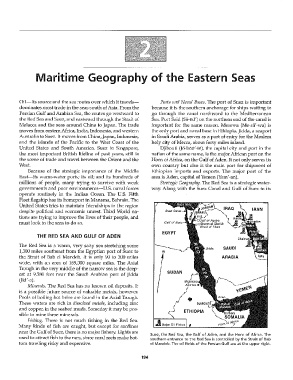
         millions  of people,  many  trying  to  survive  with weak   Strategic Geography. The Red Sea is a strategic water-
         governments and poor envirOluuents-U.s. naval forces   way. Along with the Suez Canal and Gulf of Suez to its
         operate  routinely  in  the  Indian  Ocean.  The  U.S.  Fifth
         Fleet flagship has its homeport in Manama, Bahrain. The
         United States tries to maintain friendships in the region
         despite political and economic unrest. TIurd World na-       Suez C,"'al--1
         tions are hying to improve the lives of their people, and
         must look to the seas to do so.                              Gulf of

                THE  RED  SEA AND GULF OF ADEN
         TIle Red Sea is  a warm, very salty sea  stretching some
                                                                                              SAUDI
         1,300 miles southeast from the Egyptian port of Suez to     N
         the  Strait of  Bab  el Mandeb.  It is  only  90  to  200  miles                     ARABIA
         wide,  with an area  of  169,000  square  miles.  The Axial
         Trough in the very middle of the narrow sea is the deep-
                                                                       SUDAN
         est  at  9,580  feet  near  the  Saudi Arabian port  of Jidda
         Uid' -a).
             Millerals.  The Red Sea has no known oil deposits. It
         is a possible fuhITe  source of valuable metals, hO'wever.
         Pools of boiling hot brine are found in the Axial Trough.
         These waters are rich  in dissolved  metals, including zinc
         and copper, in the seabed muds. Someday it may be pos-               ETHIOPIA
         sible to nnne these nnnerals.
            Fishillg.  TIlere  is  not much fishing  in the  Red  Sea.
         Many kinds of  fish  are caught, but except for  sardines
         near the Gulf of Suez, there is no major fishery. Lights are
                                                                Suez,  the  Red  Sea,  the  Gulf of Aden,  and  the  Horn  of Africa.  The
         used to attract fish to the nets, since coral reefs make bot-  southern entrance to the Red  Sea  is  controlled  by the Strait of Bab
         tom trawling risky and expensive.                      el  Mandeb. The oil fields of the Persian Gulf are at the upper right.


                                                            194

