


Page 204 - NS-2 Textbook
P. 204
MARITIME  GEOGRAPHY                                                                                   199


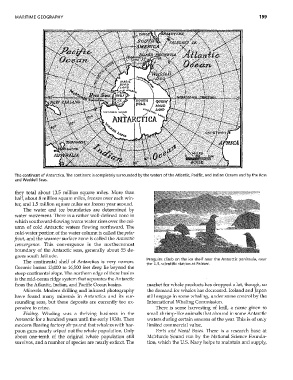
       The continent of Antarctica. The continent is completely surrounded by the waters of the Atlantic,  Pacific, and  Indian  Oceans and by the Ross
       and Weddell Seas.


       they  total  about 13.5  million  square  miles.  More  than
       half, about 8 million square lniles, freezes over each vvin-
       tel~ and 1.5 million square miles are frozen year around.
           The  water  and  ice  boundaries  are  determined  by
       water movement. There is a rather ,vell-defined zone in
       which southward-flowing '\",ann 'water rises over the col-
       umn of cold Antarctic  waters  flowing  northward.  The
       cold-water portion of the water cohUlm is called the polar
       front, and the warmer surface zone is called the Alltarctic
       converge11ce.  This  convergence  is  the  northernnlost
       boundary of the Antarctic  seas,  generally about 55  de-
       grees south latitude.
                                                              Penguins climb  on the  ice  shelf  near the Antarctic  peninsula,  near
           The  continental  shelf of Antarctica  is  very  narrmv.
                                                              the U,S.  scientific station at Palmer.
       Oceanic basins 13,000 to 16,500 feet  deep lie beyond the
       steep continental slope. The northern edge of these basins
       is the mid-ocean ridge system that separates the Antarctic
       from the Atlantic, Indian, and Pacific Ocean basins.   market fo]' whale products has dropped a lot, though, so
           Millemls.  Modern drilling and infrared photography   the demand for whales has decreased. Iceland and Japan
       have  fotmd  many  minerals  in  Antarctica  and  its  sur-  still engage in some whaling, tmder some control by the
       rounding seas, but these  deposits  are  currently  too  ex-  International Whaling Commission.
       pensive to mine.                                           There  is  SOll1e  harvesting of krill,  a name  given  to
           Fishing.  Whaling  was  a  thriving  business  in  the   small shrimp-like animals that abound in some Antarctic
       Antarctic for a htmdred years tmtil the early 19305. Then   waters during certain seasons of the year. Tbis is of only
       modern floating factory ships and fast whalers with har-  limited cOllunercial value.
       poon guns nearly wiped out the whale population. Oniy      Ports  alld  Naval  Bases.  There  is  a  research  base  at
       about  one-tenth  of  the  original  whale  population  still   McMurdo Sotmd nm by the  National Science Fotmda-
       survives, and a lllunber of species are nearly extinct. The   tion, which the u.s. Navy helps to maintain and supply,

