


Page 208 - NS-2 Textbook
P. 208
OCEANOGRAPHY                                                                                          203


       miles,  and  a  molten  outer  core  of  these  metals  about   continents and ocean basins. With an average depth of
       1,300 miles deep. Above this is about I,BOO miles of dense   about 20 nllies tmder continents, Earth's crust may be as
       rock called the mall tie.  The uppermost layer of the man-  much as  40  miles  deep  beneath mOlmtains.  Under the
       tle,  several  hundred  miles  thick,  is  called  the  astheJ1o-  oceans, however, it is only 3 to 10 miles thick.
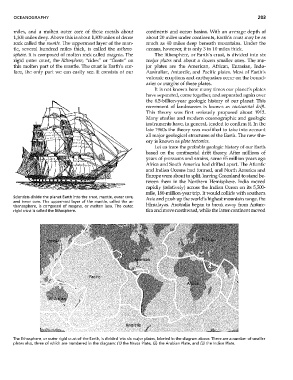
       sphere. It is composed of molten rock called magma. The    The lithosphere! or Earth's crust, is divided into six
       rigid  outer  crust,  the  lithosphere;  "rides"  or  "£loats"  on   major plates  and about a  dozen smaller ones.  The ma-
       this molten part of the mantle. The crust is Earth's sur-  jor  plates  are  the  American,  African,  Eurasian,  Indo-
       face,  the  only part we can easily see.  It consists of our   Australian, Antarctic, and Pacific plates. Most of Earth's
                                                              volcanic eruptions and earthquakes occur on the bound-
                                                              aries or lIIargills of these plates.
                                                                  It is not known how many tin1es our planet's plates
                                                              have separated, come together, and separated again over
                                                              the 4.5-billion-year geologic history  of our planet.  This
                                                              movement of landmasses  is  known  as  continental  drift.
                                                              This  theory  was  first  seriously  proposed  about  1912.
                                                              Many studies and modern oceanographic and geologic
                                                              instruments have, in general, tended to confirm it. In the
                                                              late 1960s the theory was modified to take into account
                                                              all major geological sh'uctures of the Earth. The new the-
                                                              ory is known as plate tectollics.
                                                                 Let us trace the probable geologic history of our Earth
                                                              based  on  the  continental  drift  theory.  After  millions  of
                                                              years of pressures and Shalns, SOflle 65 million years ago
                                                              Africa and South America had drifted apart. The Atlantic
                                                              and Indian Oceans had formed, and North America and
                                                              Europe were about to split, leaving Greenland to stand be-
                                                              tween  them in  the  Northern Hemisphere.  India  moved
                                                              rapidly (relatively) across the Indian Ocean on its 5,500-
                                                              mile, lBO-million-year trip. It would collide with southern
       Scientists divide the planet Earth  into the crust, mantle, outer (ore,   Asia and push up the world's highest mountain range, the
       and  inner  (ore. The  uppermost layer  of the  mantle,  called  the  as-
       thenosphere,  is  composed  of  magma,  or  molten  lava.  The  outer,   Himalayas. Australia began to break away from Antarc-
       rigid crust is called the lithosphere.                 tica and move northward, ·while the latter continent moved


       The lithosphere, or outer rigid crust of the Earth, is  divided into six major plates, labeled in the diagram above. There are a number of smaller
       plates also,  three of which are numbered in the diagram: (1) the Nazca Plate,  (2) the Arabian Plate,  and  (3) the Indian Plate.

