


Page 209 - NS-2 Textbook
P. 209
204                                                                                     NAUTICAL SCIENCES


          toward the South Pole. The African plate crashed into the   Earth's mantle like  giant chlmks  of ice,  moved by the
          Eurasian plate south of Europe and pushed up the Pyre-  churnings in the interior.  Where  these  plates come  to-
          nees mountain range between Spain and France, the Alps   gether, Earth and its inhabitants experience the awesome
          in France and Switzerland, and the Apennines of Italy. On   energy  of  earthquakes  and  volcanoes.  Seismograplls,
          the other side of the globe, the Pacific plates pushed up the   modern instnunents that measure the intensity of earth-
          Andes in South America, the Sierras along the West Coast   quakes,  have  helped  to  locate  the  boundaries  of  the
          of North America, and the islands of Japan.            plates,  called  fault  lines.  Also  along  these  bOlmdaries,
             In time the continents gradually took the places on   mOlUltains  rise  and fall  and volcanic  islands  push  up
          the globe that are familiar to us today. The major ocean   from  the  sea.  The energy  released  in  the  explosion  of
          basins  and  numerous  seas-once a  single  ocean  mass   a nuclear bomb is small compared with these huge geo-
          "vith one giant continent-now provide the vital sea lines   logie forces.
          of  cOlnmunication  and  conlmerce  between  the  -widely   Earthquakes. The great earthquake belts that lie along
          separated continents. The globe as we know it today is   the plate margins are extremely important to sailors and
          the result of a geologic process that has taken billions of   people v\Tho  live on seacoasts and in harbors. Volcanoes
          years and continues even nnw.                          have created ne,v islands and island chains-the Ha\vai-
                                                                 ian Islands, some Aleutian and Japanese islands, and is-
                    THE  EARTH'S  CRUST TODAY                    lands in the Caribbean and Mediterranean Seas, among
                                                                 others. In the United States, the entire West Coast is in an
          The evolutionary process just discussed created a global
                                                                 earthquake "belt." The best-known feature of this belt is
          jigsaw puzzle of segments known as geological plates. The   the San Andreas Fault, which runs through the center of
          plates  drift  over  the  uppermost,  semimolten  layer  of   California and close to San Francisco. In fact, some geol-
                                                                 ogists predict that all of Baja California and much of the
                                                                 present  state  of  California  may  someday  break  away
                                                                 from  the  North  American  continent  and  drift  toward
                                                                 Alaska, arriving there in about 50 million years!
                                                                     But not all such catastrophes will happen in the dis-
                                                                 tant future. In fact, many earthquakes occur daily. Tokyo,
                                                                 Japan,  for  example,  often  experiences  two  to  three
                                                                 tremors each day. Forhmately, few are ever felt by people,
                                                                 though  sensitive  seismographs  do  record  several  hun-
                                                                 dred of them each year. In 1902 MOlmt Pelee, a volcano
                                                                 near St.  Pierre  on  the  Caribbean  island  of Martinique,
                                                                 erupted with an earthquake and superheated gases that
                                                                 killed 30,000 people within seconds. In 1906 San Francisco
                                                                 was almost totally destroyed by a large quake on the San
                                                                 Andreas  Fault.  Within  the  past  ten  years,  devastating
                                                                 quakes have killed thousands of people in Italy, Iran, Pak-
                                                                 istan, Turkey, Greece, Guatemala, Nicaragua, Mexico, and
                                                                 the former Soviet Union. Another less serious but widely
                                                                 reported quake disrupted the baseball World Series in Oc-
                                                                 tober 1989 in San Francisco, causing much damage and at
                                                                 least sixty-three confirmed deaths. The largest disaster of
                                                                 all  time  from  a  single  earthquake  occurred  in  1976  in
                                                                 Tangshan, China, when almost 700,000  people were re-
                                                                 ported to have been killed.
                                                                    Tsul1ami.  When an earthquake or volcanic explosion
                                                                 happens near or lmder the sea, ocean waves radiate from
                                                                 it in ever-widening circles. TIl€f€ may be little movement
                                                                 detected on the open sea, but as these waves reach shallmv
                                                                 ,vaters along coastlines, the waves slow dmvn and pile up
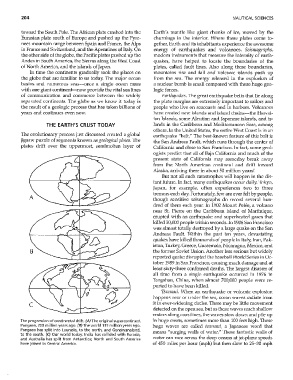
          The progression of continental drift. (A) The original supercontinent   in huge crests, sometimes more than 100 feet high. These
          Pangaea, 200 million years ago. (8) The world 135 million years ago.   huge  ·waves  are  called  tSll1w11li,  a  Japanese  ,vard  that
          Pangaea  has split  into  Laurasia,  to the  north,  and  Gondwanaland,   means "surging ,valls of water." 111€Se  fantastic  walls of
          to the south.  (e)  Our  world  today.  India  has  collided  with  Eurasia,
          and  Australia  has  split  from  Antarctica;  North  and  South  America   water can race across the deep oceans at jet-plane speeds
          have joined in Central America.                        of 450 miles per hour (mph) but then slow to 25-30 mph

