


Page 212 - NS-2 Textbook
P. 212
OCEANOGRAPHY                                                                                          207


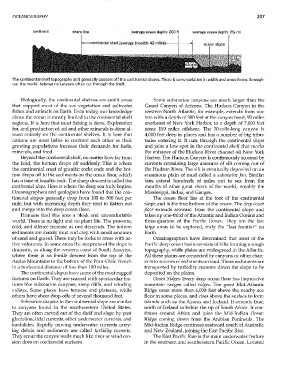
               continent       shore line               average ocean depth: 200 fJ   average ocean depth: 2% mi

                                   r--c'ont.inental shelf (average breadth: 42 miles)--+--+j


      The continental shelf topography as it generally appears off the continental shores. There is some variation in width and smoothness through-
      out the world. Submarine canyons  often cut through the shelf.


          Biologically, the continental shelves are sunlit areas   Some submarine canyons are much larger than the
      that support most of  the  sea  vegetation  and  saltwater   Grand Canyon of Arizona. The Hudson Canyon in the
      fishes and animals on Earth. Even today, om knowledge   western North Atlantic, for  example, extends from wa-
      about the ocean is mostly limited to the continental shelf   ters with a depth of 300 feet at the canyon head, 90 nllies
      regions. It is here that most fishing is done. Exploration   southeast of New York HarbOl,  to  a depth of 7,000 feet
      for, and production of, oil and other minerals is done al-  some  150  miles  offshore.  The  50-mile-long  canyon  is
      most entirely on the continental shelves.  It is here  that   4,000 feet deep in places and has a number of big tribu-
      nations  are  most liable  to  confront  each  other as  their   taries  entering it.  It cuts  through  the  continental slope
      growing  populations  increase  their  demands for  fuels,   and joins a low spot in the continental shelf that marks
      minerals ..  and food.                                 the entrance of the Hudson River channel off New York
          Beyond the continental shelf, no matter how far from   Harbor. The Hudson Canyon is continuously scoured by
      the land, the bottom drops off suddenly. This is where   currents containing large amounts of silt coming out of
      the continental crust of granitic rocks ends and the bot-  the Hudson River. The silt is eventually deposited on an
      tom drops off to the sediments on the ocean floor, which   enormous  plain of mud called  a  submarine fan.  Similar
      has a base of basaltic rock. The sharp descent is called the   fans  extend  hundreds  of  miles  out  to  sea  from  the
      cOlltillental slope. Here is where the deep sea truly begins.   mouths of other great rivers  of the world, notably the
      Oceanographers and geologists have found that the con-  Mississippi, Indus, and Ganges.
      tinental slopes  generally drop from  100  to 500  feet per   The  ocean  floor  lies  at  the  foot  of  the  continental
      mile, but with increasing depth they tend to flatten out   slope and is the true bottom of the ocean. T1,e deep  ocean
      and merge into the deep ocean floor.                   floor  extends  seaward  from  the  continental  slope  and
          Humans  find  this  area  a  bleak  and uncornlortable   takes up one-third of the Atlantic and Indian Oceans and
      world. There is no light and no plant life. The pressure,   three-quarters  of  the  Pacific  Ocean.  They  are  the  last
      cold, and silence increase as  one descends.  The bottom   large  areas  to  be explored,  truly  the  "last frontier"  on
      sediments are mainly mud and clay; with small amolmts   Earth.
      of sand and gravel. There may be rocks in areas with ac-   Oceanographers have determined that most of  the
      tive volcanoes. In some areas the steepness of the slope is   Pacific deep ocean basin consists of hills forming a rough
      dramatic}  as  along the ·western coast of South America,   topography, while plains are widespread in the Atlantic.
      where  there  is  an  8-mile  descent  from  the  top  of  the   All these plains are connected by canyons or other chan-
      Andes Mountains to the bottom of the Peru-Chile Trench   nels to sources of sediments on land. These sediments are
      in a horizontal distance of less than 100 miles.       transported by turbidity currents down the slope to be
          The continental slopes have some of the most rugged   deposited on the plains.
      features on Earth. 111ey are scarred with spectacular fea-  Oceall Ridges. Every deep ocean floor has impressive
      hues like sublnarine canyons, steep cliffs!  and winding   mow1tain  ranges  called  ridges.  The  great  Mid-Atlantic
      valleys.  Some  places  have  terraces  and  plateaus,  while   Ridge  soars more than 6,000  feet above  the nearby sea
      others have sheer drop-offs of several thousand feet.   floor in some places, and rises above the surface to form
          Submarille callyons in the continental slope are similar   islands such as the Azores and Iceland. It extends from
      to  canyons  fOlmd  in  the  southwestern  Unlted  States.   north of Iceland to below the tip of South Africa. It con-
      111ey are often carved out of the shelf and slope by past   tinues  around Africa  and  joins  the  Mid-Indian  Ocean
      glaciation, tidal currents, other lmderwater currents, and   Ridge  coming  down  from  the  Arabian  Penlnsula.  The
      landslides. Rapidly moving underwater currents carry-  Mid-Indian Ridge continues eastward south of Australia
      ing  debris  and  sediments  are  called  turbidity  currents.   and New Zealand, joining the East Pacific Rise.
      They scour the canyon \vaBs much like river or wind ero-   The East Pacific Rise is the main underwater feature
      sion does on continental surfaces.                     in the southern and southeastern Pacific Ocean. Located

