


Page 214 - NS-2 Textbook
P. 214
OCEANOGRAPHY                                                                                          209


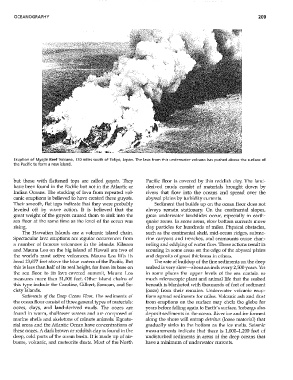
       Eruption  of Myojin Reef Volcano,  170 miles south  of Tokyo,  Japan. The  Java  from this  underwater volcano  has  pushed  above the surface  of
       the Pacific to form  a new island.


       but  those  with  flattened  tops  are  called  guyots.  TIley   Pacific  floor  is  covered by this reddish clay.  The land-
       have been found in the Pacific but not in the Atlantic or   derived  muds  consist  of  materials  brought  down  by
       Indian Oceans. The stacking of lava from repeated vol-  rivers  that  flow  into  the  oceans  and  spread  over  the
       canic eruptions is believed to have created these guyots.   abyssal plains by turbidity currents.
       Their smooth, flat tops indicate that they were probably   Sediment that builds up on the ocean floor does not
       leveled  off  by  wave  action.  It  is  believed  that  the   always  remain  stationary.  On  the  continental  slopes!
       great weight of the guyots caused them to sink into the   great  underwater landslides  occur,  especially  in earth-
       sea floor at the same time as the level of the ocean was   quake zones. In some areas, slow bottmn currents move
       rising.                                                clay particles for hundreds of miles.  Physical obstacles,
          The  Hawaiian Islands  are  a  volcanic  island  chain.   such as the continental shelf, ntid-ocean ridges, sublna-
       Spectacular lava eruptions are regular occurrences frOln   rine  canyons and  trenches,  and  seamounts cause chan-
       a  number of  famous  volcanoes  in the  islands.  Kilauea   neling and eddying of water flow. These actions result in
       and Matma Loa on the big island of Hawaii are two of   scouring in some areas on the edge of the abyssal plains
       the  world's most active volcanoes.  Mauna Loa  lifts its   and deposits of great thickness in others.
       head 13,677 feet above the blue waters of the Pacific. But   The rate ofbuiJdup of the fine sediments on the deep
       this is less than half of its real height, for from its base on   seabed is very slo,v-about an inch every 2,500 years. Yet
       the  sea  floor  to  its  lava-covered  summit,  Matula  Loa   in some  places  the  upper  levels  of  the  sea  contain  so
       measures more than 31,000 feet.  Other island chains of   much microscopic plant and animal life that the seabed
       this type include the Caroline, Gilbert, Samoan, and So-  beneath is blanketed with thousands of feet of sediment
       ciety Islands.                                         (ooze)  fronl  their  relnains.  Underwater  volcanic  erup-
          Sedi11leuts  of the  Deep  Ocean  Floor.  The sediments of   tions spread sediments for nmes. Volcanic ash and dust
       the ocean floor consist of three general types of materials:   from  eruptions on the  surface may circle  the  globe  for
       oozes,  clays,  and  land-derived  muds.  The  oozes  are   years before falling again to Earth's surface. Icebergs also
       found in warm, shallower waters and are composed of    deposit sediments in the ocean. River ice and ice formed
       marine shells and skeletons of minute animals. Equato-  along the shore will entrap detritlls  (loose material) that
       rial areas and the Atlantic Ocean have concentrations of   gradually sinks  to  the bottom as  the ice  melts.  Seismic
       these oozes. A dark brown or reddish clay is fOtmd in the   measurements indicate  that there  is  1,000-1,200 feet  of
       deep, cold parts of the ocean basin. It is made up of air-  undisturbed sediments in areas of the deep oceans that
       borne, volcanic, and meteorite dusts. Most of the North   have a minimum of lUldenvater cunents.

