


Page 219 - NS-2 Textbook
P. 219
214                                                                                      NAUTICAL SCIENCES


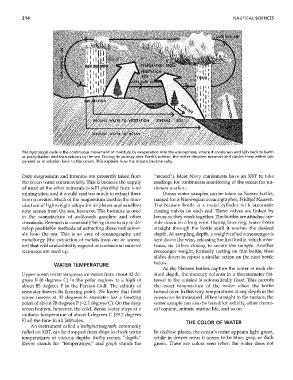
          The hydrologic cycle is the continuous movement of moisture by evaporation into the atmosphere, where it condenses and falls back to Earth
          as  precipitation and then returns to the sea.  During  its journey over Earth's surface, the water dissolves minerals and carries them either sus-
          pended or in  solution back to the ocean. This explains how the oceans became salty.


          Only magnesium and bromille are presently taken from    "record"). Most Navy combatants have an XBT  to take
          the ocean water commercially. TIus is because the supply   readings for continuous lllOlutoring of the ocean for  lUl-
          of most of the other millerals is still plentiful from land   dersea vvarfare.
          milling sites, and it would cost too much to extract them   Ocean water samples can be taken in Nmlsell  bottles,
          from semvater. Much of the magnesiunl used in the man-  named for a Norwegian oceanographer, Fridtjof Nansen.
          ufacture of lightweight alloys for airplanes and satellites   The  Nansen bottle  is  a  llletal  cylinder  ,vith  automatic
          now comes from the sea, however. TIle bromine is used   closing valves on each end. These valves are linked by
          in  the  manufacture  of  antiknock  gasoline  and  other   levers so they work together. The bottles are attached up-
          chemicals. Research is constantly being done to try to de-  side dmNn on a long ,viTe. During lmvering, 'vater flows
          velop profitable methods of extracting dissolved miner-  straight  through  the bottle  until it reaches  the  desired
          als  from  the  sea.  TI,is  is  an area  of  oceanography and   depth. At sampling depth, a weight called a messenger is
          metallurgy (the extraction of metals from  are or seawa-  sent down the ,viTe, releasing the first bottle, -which over-
          ter) that will undoubtedly expand as continental mineral   till'ns,  its  valves  closing to  seClU'e  the  sample,  Another
          resources are used up.                                  messenger weight, formerly resting on that bottle, then
                                                                  slides down to repeat a similar action on the next bottle
                                                                 belmv.
                        WATER TEMPERATURE
                                                                     As the Nansen bottles capture the water at each de-
          Upper ocean water temperature varies from about 32 de-  sired  depth, the merCluy column in a thermometer fas-
          grees F  (0  degrees  C) in the  polar regions  to  a high of   tened to the outside is automatically fixed. TI1is records
          about 85  degrees F in  the Persian Gulf.  The  salinity of   the  exact  temperature  of  the  water  when  the  bottle
          seawater lowers its freezing point.  We  know that fresh   turned over. In tllis way, temperatures at any depth in the
          water  freezes  at  32  degrees  F;  seawater has  a freezing   ocean can be measured. -When brought to the surface, the
          point of about 28 degrees F (-2.2 degrees C). On the deep   water sample can also be tested for salinity, other chemi-
          ocean bottOlll, hmvever, the cold, dense ,vater stays at a   cal content, llUnute Inarine life, and so on.
          uniform temperature of about 4 degrees C (39.2 degrees
          F) all the time in all latitudes.                                    THE  COLOR OF WATER
              An instrument called a bathythermograph, commonly
          called an XBT, can be dropped from ships to check water   In shallow places, the ocean's water appears light green,
          temperatures  at various  depths  (bathy  means  "depth,"   \vhile in deeper areas  it seelns to be blue, gray,  or dark
          thermo  stands  for  "temperature,"  and graph  stands  for   green,  These  are  colors  seen -when  the  water  does not

