


Page 220 - NS-2 Textbook
P. 220
OCEANOGRAPHY                                                                                          215


       contain silt or  mud near  shore  Of  the mouths of rivers.   200 meters). Below the twilight zone is the area of total
       The  colors  change  depending  on whether  the  day  is   and eternal darkness called the dark  ZOl1e.  TIus is a very
       cloudy or sunny. Actually, the water itself has no color.   thick layer in which no plants grow and animal life con-
       What we see as its color is caused by the reflection of the   sists of carnivores and deh'itus (particles of plant or ani-
       sky or scattering of light in the water. Some ocean bodies   mal matter) feeders. This area has no light at all except
       have been given theil' names because they are colored at   that which is created by an object or animal itself.
       times by plant or aninlallife in them, or by colored silt
       flowing into them. TI1e Red Sea, for instance, is so named
       because of the red phytoplankton in the water. The Yel-
                                                                                   WAVES
       low Sea is so named because of the yellow clay silt car-
       ried into it by the rivers of northern China.          Waves in a liquid are caused by any energy source that
          We know that the main source of energy for life is the   dishtrbs  the  water surface.  The  energy  transnutted by
       Stm. Its  radiant energy reaches  us after traveling about   ocean waves can be very great. Blocks of stone weighing
       eight minutes and some 93 million miles through the void   more than 1,300 tons have been moved by ·waves.
       of space. Stmlight consists of a range or spectrum  of dif-  Any dishrrbance, even a  raindrop in a puddle, will
       ferent wavelengths of energy. These include infrared, vis-  create ripples of tiny waves. The tsunami 'waves caused
       ible, ultraviolet,  and x-rays.  The  different colors  of  the   by an exploding undersea volcano or an earthquake can
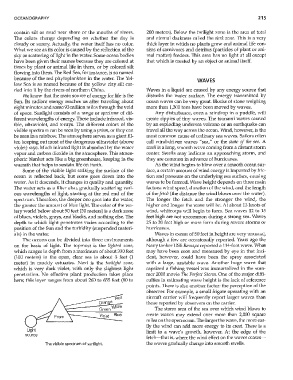
       visible spectrum can be seen by using a prism, or they can   travel all the way across the ocean. Wind, ho\,vever, is the
       be seen in a rainbow. The atmosphere serves as a giant fil-  most common cause of ordinary sea waves. Sailors often
       ter, keeping out most of the dangerous ultraviolet (above   call ,vind-driven  waves  I1sea,"  or  the  state  of the  sea.  A
       violet) rays. Much infrared light is absorbed by the water   swell is a long, smooth wave coming from a distant storm
       vapor and carbon dioxide in the atmosphere. This atmos-  center.  Swells may indicate an approaching storm, and
       pheric blartket acts like a big greenhouse, keeping in the   they are common in advance of hurricanes.
       warmth that helps to sustain life on Earth.                As the wind begins to blow over a smooth ocean sur-
           Some of the visible light striking the surface of the   face, a certain amotult of wind energy is imparted by fric-
       ocean  is  reflected  back,  but some  goes  down into  the   tion and pressure on the underlying sea smface, causing
       water. As it descends, it changes in quality and quantity.   waves to be formed. Wave height depends on three main
       The water acts as a filter also, gradually scattering vari-  factors: wind speed, duration of the wind, and the length
       ous wavelengths of light, starting at the red end of the   of the fetch  (the distance the wind blows over the water).
       spectrum. Therefore, the deeper one goes into the wate,;   The  longer  the  fetch  and  the  stronger  the  wind,  the
       the greater the amount of blue light. The color of the wa-  higher and longer the wave will be. At about 13 knots of
       tery world below about 90 feet (30 meters) is a dark zone   wind, whitecaps will begin to form.  Sea waves 12 to 15
       of blues, violets, grays, and blacks, and nothing else. The   feet high are not tulcommon during a strong sea. Waves
       depth to which light penetrates varies according to the   25  to 30 feet high or more form during severe storms or
       position of the Stul and the turbidity (suspended materi-  hurricanes.
       als) in the water.                                         Waves in excess of 50 feet in height are very tulusual,
           The oceans can be divided into three environments   although a few are occasionally reported. Years ago the
       on  the  basis  of  light.  The  topmost is  the  lighted  ZOlle,   Navy tartker USSRamapo reported a 114-footwave. What
       which ranges in depth from a maximum of about 330 feet   may have been seen and measured by eye in that inci-
       (100  meters)  in  the  open,  clear  sea  to  about  3  feet  (1   dent,  howeve1~ could  have  been  the  spray  associated
       meter)  in  muddy  estuaries.  Next  is  the  twilight  ZOlle,   with  a large,  unstable  wave.  Another huge \i\Tave  that
       which is  very  dark violet, with only  the  slightest light   capsized a fishing vessel -was inunortalized in the sum-
       penetration.  No  effective  plant production  takes  place   mer 2000 movie Tile Perfect 5t01'111.  One of the major diffi-
       here; this layer ranges from  about 260 to 655 feet (80  to   culties in estinlating wave height is the lack of reference
                                                              points. There is also another factor: the perception of the
                                                              observer. For exanlple, a small frigate operating with an
                                                              aircraft carrier -will  frequently  report larger ,v-aves  than
                                                              those reported by observers on the carrier.
                                                                  The  storm area  of the sea over \i\Thich  wind blows to
                                           Violet  Blue       create  waves  1nay  extend  over  more  than  2,000  square
                        Prism
                                                              miles on the open ocean. The larger the wave, the more eas-
                                                              ily the wind can add more energy to its crest.  There is a
            Light                                             limit  to  a  wave's  growth,  however.  At  the  edge  of  the
            source
                                                              fetch-that is, where the '\-vind effect on the -waves ceases-
                    The visible spectrum of sunlight.         the waves gradually change into smooth swells.

