


Page 221 - NS-2 Textbook
P. 221
216                                                                                     NAUTICAL SCIENCES


             Waves are normally described by certain terms. The
          top of a  wave is  called the crest,  while the lowest part,
          usually between  two  waves,  is  called  the  trough.  The
          height of a wave is the vertical distance between the crest
          and the trough, while the length of the wave (the wave-
          length) is the horizontal distance between two successive
          crests.  The length of time it takes for  a  complete wave
          (successive  crests  or  troughs)  to  pass  a  given point is
          called the period of the wave. Normally wind waves have
          short periods, ranging from 2 to 5 seconds. Swells far in
          advance of a major storm may have a period of from 12
          to 15 seconds. The period of a tSlmami wave ranges from
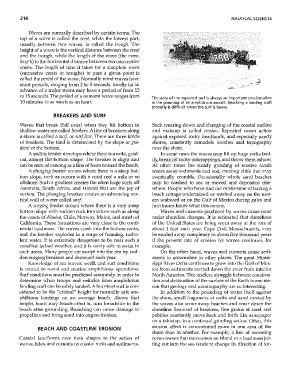
                                                                 The state of the expected surf is always an important consideration
          10 minutes to as much as an hour.                      in the planning of an  amphibious assault.  Beaching a landing craft
                                                                 properly is  difficult when the surf is  heavy.
                        BREAKERS  AND SURF
          Waves  that  break  (fall  over)  when  they hit bottom  in   Such wearing down and changing of the coastal outline
          shallow water are called breakers. A line of breakers along   and  makeup  is  called  erosion.  Repeated  ocean  action
          a shore is called a SlIIj, or swj !ine.  There are three kinds   against exposed rocky headlands, and especially sandy
          of breakers. The kind is determined by the slope or gra-  shores,  constantly  remodels  beaches  and  topography
          dient of the bottom.                                   near the shore.
             A spilling breaker develops where there is a mild, grad-  In some cases the waves may lift up huge rocks bod-
          ual, almost flat bottom shape. The breaker is slight and   ily, break off rocky outcroppings, and throw them ashore.
          can be seen advancing as a line of foam toward the beach.   At  other  times  the  steady  grinding  of  erosive  sands
             A plunging breaker occurs where there is a steep bot-  wears away sediments and soil, creating cliffs that may
          tom slope, such as occurs with a coral reef a mile Of so   eventually  crumble.  Occasionally  whole  sand  beaches
          offshore. Such a gradient creates the often huge surfs off   may be  washed  to  sea  or  moved  and  deposited  else-
          Australia,  South Africa,  and Hawaii that are  the joy of   where. People who have had the misforhme of having a
          surfers. The plunging breaker creates an advancing ver-  beach cottage undermined or washed away on the east-
          tical wall of water called swt                         ern seaboard or on the Gulf of Mexico during gales and
             A surgillg breaker occurs where there is a very steep   hurricanes know what this means.
         bottom slope with sudden rock formations such as along     Waves and currents produced by waves cause most
         the coasts of Alaska, Chile, Norway, Maine, and much of   major shoreline changes. It is  estimated that shorelines
          California. These formations are very close to the conti-  of the United States are being worn away at the rate of
         nentallandmass. The waves crash into the bottom rocks,   about 1 foot  each year.  Cape Cod, Massachusetts, may
         and the breaker explodes in a surge of foaming,  turbu-  be eroded away completely in about five thousand years
         lent water.  It is  extremely dangerous to be near such a   if  the  present  rate  of erosion  by  waves  continues,  for
         coastline in bad weather, and it is rarely safe to swim in   example.
         such areas. Many people are swept into the sea by sud-     On the other hand, waves and currents cause sedi-
         den surging breakers and drowned each year.             ments  to  accumulate  in other places.  The  great Missis-
             Knowledge of sea waves, s"\vell J  and surf conditions   sippi River Delta continues to grow into the Gulf of Mex-
         is  crucial  to  naval  and  marine  amphibious  operations.   ico from sediments carried down the river from interior
         Surf conditions must be predicted accurately in order to   North America. TItis endless struggle between construc-
         determine  when troops  and vehicles from  amphibious   tion and destruction of the surface of the Earth is one rea-
         landing craft can be safely landed. A four-foot surf is con-  son that geology and oceanography are so interesting.
         sidered to be the" critical" height for normally safe am-  In addition to the pounding of water itself against
         phibious  landings  on  an  average  beach.  Above  that   the shore, small fragments of rocks and sand carried by
         height, boats may broach-that is, turn broadside to the   the waves also scour away beaches and wear down the
         beach after grounding. Broaching can cause damage to    shoreline. Seaward of breakers, fine grains of sand and
         propellers and bring sand into engine intakes.          pebbles constantly move back and forth like sandpaper
                                                                 on a tabletop, in a continual grinding action. Often, this
                 BEACH  AND  COASTLINE  EROSION                  erosion  effect  is  concentrated  nlore  in  one  area  of  the
                                                                 shore than in another.  For example,  a line of incoming
         Coastal  landforms  owe  their  shapes  to  the  action  of   ocean waves that encounters an island or a landmass jut-
         waves, tides/ and currents on coastal rocks and sediments.   ting out into the sea tends to change its direction of for-

