


Page 222 - NS-2 Textbook
P. 222
OCEANOGRAPHY                                                                                          217


       ward motion. The waves align themselves with the bot-  ing parallel  to  the beach in a  definite flow  and  speed.
       tom contours as well as conform to the general slope of   Such cmrents carry scoming sediments to and from the
       the coastline.  When one part of the line develops  drag   beach out to deeper water. In the process, they may de-
       and  changes  direction  or  bends  because  of  shallower   stroy  the  beach  and  make  real  estate  along  that  area
       water, this response is called refraction. Such information   nearly worthless.  They  also  sometimes create bars  that
       is very important when an amphibious assault is being   become navigational hazards.  Groins  serve  as  dams  to
       planned.                                               stop the movement of sediments by these cmrents. They
           Engineers must also know the "\,\Tay water waves are   may protect a  given beach, but such interference  with
       bent so they can take advantage of natural phenomena   natural processes may also result in more erosion farther
       when designing structures to protect shorelines and har-  down the beach from waves.  Careful surveys must be
       bors. They must know where the natural energy is con-  made before such structures are built.
       centrated and where it is weaker so they can build for     Rip  Currents.  Rip  currents  are  strong,  seavvard-
       greatest effect and economy.                           moving cmrents that occur along some shores. They re-
           The most common structme built to protect harbors   turn excess water that has been pushed ashore by strong
       is  the  breakwater.  A  breakwater  is  a  line  of  big  rocks,   waves. They occur when a longshore cunent moving in
       sometimes strengthened by steel-reinforced  concrete. It   one direction parallel to a beach hits another longshore
       may be a single structme protecting a harbor entrance, or   cmrent moving in the opposite direction. The result is a
       a  series  of segments  that  actually  create  and protect a   strong movement of water outward to the breaker line
       harbor or an anchorage. In the latter case, there will nor-  and even beyond.
       mally be two or more harbor entrances and exits for ship-  Rip cmrents are often incorrectly called undertow (the
       ping. A breakwater is designed to protect ships at anchor   seaward and downward thrust of a wave as it breaks).
       or alongside piers in a harbor from waves, swells, or sluf.   But  these  currents  do  not  actually  pull  swimmers  or
           Another  common  structure  along  inhabited  sea-  waders dowll.  They may upset a  wader and will pull a
       coasts  is  the groin.  Usually built in a  series  of  two or   swinuner out  from  shore  to  deep 'vater.  Some rip  cur-
       more, groins are walls of stone or wooden pilings built at   rents are fast, moving at speeds of up to 2 miles an hom.
       right angles to a shoreline to prevent erosion by longshore   Rip cmrents can be very dangerous to those who do
       Clirrents. Longshore currents are part of the water move-  not swim or to  the swimmer who tries to fight the rip.
       ment associated with incoming ocean waves. Since -water   Even a good swimmer may tire quickly trying to swim
       from  these  waves  is  continually  moving  shoreward,   against such a cmrent. If caught in a rip, you must not
       there must be some way for this water to return to sea. In   fight the cmrent. Rip cmrents are rarely more than 100
       many beach areas, this results in some of the water mov-  feet wide, so the best advice is to swim parallel  to the


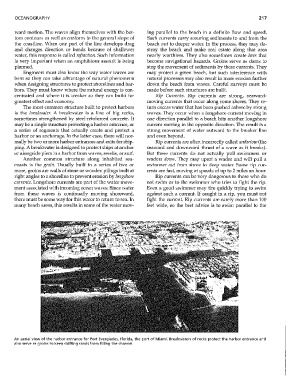
       An  aerial view of the harbor entrance for Port Everglades,  Florida, the port of Miami. Breakwaters of rocks  protect the harbor entrance and
       also serve  as  groins to keep shifting sands from filling the channeL

