


Page 224 - NS-2 Textbook
P. 224
OCEANOGRAPHY                                                                                         219


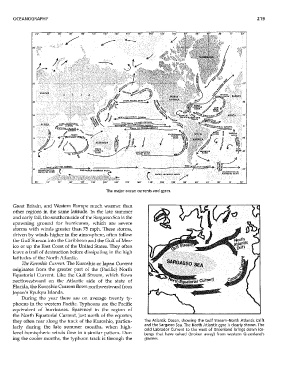
                                             The  major ocean currents and gyres.


      Great  Britain!  and  Western  Europe much V\Tarmer  than
       other regions in the same latitude.  In the late  summer
       and early fall, the southem side of the Sargasso Sea is the
       spawning  ground  for  hurricanes!  'which  are  severe
       storms with winds greater than 75  mph. These storms,
       driven by winds higher in the atmosphere, often follow
       the Gulf Stream into the Caribbean and the Gulf of Mex-
       ico or up the East Coast of the United States. TIley often
      leave a trail of destruction before dissipating in the high
      latihtdes of the North Atlantic.
          The Kuroshio Current. TIle Kuroshio or Japan Current
      originates  from  the  greater  part of  the  (Pacific)  North
      Equatorial Current.  Like  the  Gulf Stream, which flows
      northwestward  on  the  Atlantic  side  of  the  state  of                    current
      Florida, the Kuroshio Current flows northwestward from
      Japan's Ryukyu Islands.                                                              r
          During  the  year  there  are  on  average  hventy  ty-
      phoons in the western Pacific.  Typhoons are the Pacific
      equivalent  of  hurricanes.  Spawned  in  the  region  of
      the North Equatorial Current, just north of the equator,
      they often roar along the track of the Kuroshio, particu-  The  Atlantic Ocean,  showing  the  Gulf Stream-North  Atlantic Drift
      larly  during  the  late  summer  months,  when  high-  and the Sargasso  Sea.  The North Atlantic gyre is  clearly shown. The
                                                             cold  Labrador  Current  to the  west  of Greenland  brings  down  ice-
      level hemispheric vdnds flow in  a similar pattern.  Dur-  bergs  that  have  calved  (broken  away)  from  western  Greenland's
      ing the cooler months, the typhoon track is through the   glaciers.

