


Page 232 - NS-2 Textbook
P. 232
OCEANOGRAPHY                                                                                          227

       throughout  the  seas,  but  most  live  in  the  shallow,   Twenty-three species of crocodiles inhabit much of the
       warmer seas. Within this group are five  subgroups:  (1)   waters of the tropical zones around the world. TIlese in-
       bottom-living  fishes  of  both  shallow  and  deep  seas,   clude the American alligator, found in marshes, s"\vamps,
       which have large heads and whip tails; (2) large carnivo-  rivers, lakes, tidal areas, and sometimes the ocean in the
       rous fishes with tough, leathery skins and sharp cutting   southeastern  United  States;  the  American  crocodile,
       teeth, such as the sharks and rays; this group includes the   found  in  southern  Florida,  Central  America,  South
       largest fish-the whale shark, basking shark, and manta   Anlerica,  and various Caribbean islands;  and 21  other
       ray;  (3)  sturgeons, which have bony plates on the skin   species found in Asia, Africa, Aush'alia, and other Pacific
       and  are  commercially  valuable  for  their  eggs,  called   and Indian Ocean regions.  They are  very hardy, tough
       caviar; (4)  the largest group, which includes most com-  animals  that have survived, basically tffichanged, from
       nlercial fishes, such as cod, herring, turbot, salmon, hma,   prehistoric times. They range in size from a few feet to as
       mackerel, flounder, bass, and many others; and (5) lung-  long as 20 feet or more. TIle smaller ones feed on insects,
       fish, three of which are freshwater types, and one called   snakes, turtles,  slow-nloving fish,  small mammals, and
       the coelacanth. This oddity, once thought to have died out   birds. Large adults may eat larger mammals and, on oc-
       some  50  million  years  ago,  was  found  in  the  Indian   casion, may attack tm,vary people.
       Ocean in 1938. An occasional specimen has been caught      The  seabird  group  includes  a  number  of different
       from time to tinle since.                              species. The waders live and feed along the shallows, in
           TIle reptile group has only a small number of species   eshmries  of rivers  affected  by  tides,  in  ponds,  and  in
       that live in the sea today-a far cry from the Age of Rep-  mangrove swamps. Birds of the open sea, such as the al-
       tiles,  when they were the dominant form of life in the   batross  and  petrel,  live  most  of  the  time  in  the  open
       world ocean. Reptiles are cold-blooded. That means they   ocean, coming ashore  only to breed.  The  emperor pen-
       cannot regulate  their  temperatures as mammals do,  so   guin lays its eggs on sea ice in Antarctica. It is the only
       they usually inhabit warm tropical seas. There are four   bird that never comes ashore. There are many other vari-
       groups of living marine reptiles: turtles, marine iguanas,   eties  of  penguins,  all  of  them  in  the  Southern Henti-
       sea snakes, and a few ocean crocodiles.                sphere. Seabirds feed mainly on fish. As penguins cannot
           Sea turtles grow to a huge size. The rare leatherback   fly,  they catch fish  by diving and  swimming.  Pelicans
       sometinles exceeds 6 feet in length and weighs over half   and gannets catch them by diving. Gulls and terns spot
       a  ton. Turtles swim with flippers.  They come ashore to   and then pounce on their prey from the air.
       lay their eggs in holes dug in the sand. There, they are at   The mammal group has a limited number of marine
       the mercy of many different kinds of predators. Few of   species, but they are some of the world's most interesting
       the young make it back to the sea before being eaten by   animals. They include the polar bear and sea otter, which
       seabirds.                                              are sinillar in most characteristics to land aninlals but are
           Marine igllanas live only in the Galapagos Islands of   adapted to the  sea.  The polar bear has extra-long legs,
       Ecuador, off the west coast of South America. They are   which makes it a powerful swilruner, and a thicker coat,
       the only marine lizards. They live in large herds on the   which insulates it against the icy waters and winds of the
       rocks near shore and feed on seaweed.
           Sea sl1akes are poisonous, some related to cobras and
       kraits. They have paddlelike flat tails so they can swlll.
       TIley  inhabit  sheltered  coastal  waters,  especially  near
       river  mouths,  and  some  live  in  brackish  water  up-
       stream. There are nearly fifty species of these poisonous
       snakes living in the tropical Pacific and Indian Oceans.
       They range from East African waters throughout south-
       ern and Southeast Asia, Oceania, Australia, and in the
       warm Japan  Current  all  the  way  north to Japan  and
       Korea.  A  few  species  exist  along  the  Pacific  coast  of
       Central and South America.  Although  sea  snakes  are
       poisonous, they do not disturb swimmers and are said
       not to bite unless forcibly restrained. They feed on fish,
       mostly at night. This makes them dangerous to fisher-
       men who  may net  them  when  they  are  attracted  by
       schools  of fish  and  the  lights  of  fishing  boats.  Asian
       fishermen are said to  throw them from their nets with
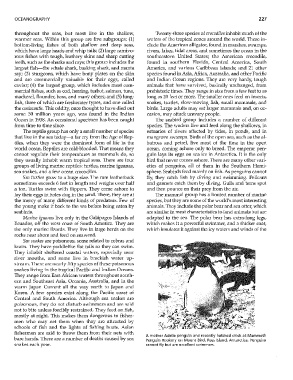
                                                              A  mother Adelie  penguin  and  recently hatched chick  at Mammoth
       bare hands. There are a number of deaths caused by sea   Penguin  Rookery on  Mount Bird,  Ross  Island,  Antarctica.  Penguins
       snakes each year.                                      cannot fly but are excellent swimmers.

