


Page 235 - NS-2 Textbook
P. 235
230                                                                                     NAUTICAL SCIENCES


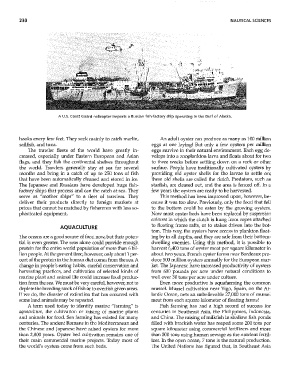
                         A U.S.  Coast Guard  helicopter inspects a Russian  fish-factory ship operating in the Gulf of Alaska.


         hooks every few feet. They seek mainly to catch marlin,    An adult oyster can produce as many as 100 million
         sailfish, and tuna.                                    eggs at one laying!  But only a  few  oysters per million
             The  trawler  fleets  of  the  world  have  greatly  in-  eggs survive in their natural environment. Each egg de-
         creased,  especially under Eastern  European and Asian   velops into a zooplankton larva and floats about for two
         flags,  and they  fish  the continental shelves  throughout   to three weeks before settling down on a  rock or other
         the  world.  Trawlers  generally  stay  at  sea  for  several   surface. People have traditionally cultivated oysters by
         months and bring in a  catch of up to  250  tons  of  fish   providing old oyster shells  for  the  larvae  to  settle  on;
         that have been automatically cleaned and stored in ice.   these old shells are called the clutch.  Predators, such as
         The Japanese  and Russians have developed  huge fish-  starfish, are cleared out, and the area is fenced off. In a
         factory ships that process and can the catch at sea. TIley   few years the oysters are ready to be harvested.
         serve  as  "mother  ships"  to  a  fleet  of  trawlers.  They   This method has been improved upon, however" be-
         deliver  their  products  directly  to  foreign  markets  at   cause it was too slow. Previously, only the food that fell
         prices that cannot be matched by fishermen with less so-  to  the  bottom could be  eaten  by  the  growing  oysters.
         phisticated equipment.                                 Now most oyster beds have been replaced by suspension
                                                                cultures in which the clutch is hung from ropes attached
                                                                to floating frame rafts, or to stakes driven into the bot-
                          AQUACULTURE
                                                                tom. This way, the oysters have access to plankton float-
         The oceans are a good source of food now, but their poten-  ing by in all depths, and they are safe from their bottom-
         tial is even greater. The seas alone could provide enough   dwelling  enemies.  Using  this  method, it is  possible  to
         protein for the entire world population of more than 6 bil-  harvest 6AOO tons of oyster meat per square kilometer in
         lion people. At the present tinle, however, only about 1 per-  about two years. French oyster farms near Bordeaux pro-
         cent of tile protein in the human diet comes from the sea. A   duce 500 million oysters armually for the European mar-
         change in people's eating habits, careful conservation and   ket. The Japanese have increased productivity of oysters
         harvesting practices, and cultivation of selected kinds of   from  600  pounds per acre  lmder natural conditions  to
         marine plant and animal life could increase food produc-  well over 30 tons per acre under culture.
         tion from the sea. We must be very careful, however/ not to   Even more productive is aquafarming the common
         deplete the breeding stock of fish 01' to overfish given areas.   mussel. Mussel cultivation near Vigo, Spain, on the At-
         If we do, the disaster of extinction that has occurred with   lantic Ocean, nets an unbelievable 27,000 tons of mussel
         some land animals may be repeated.                     meat from each square kilometer of floating farms!
             A term used today  to identify marine  ilfanning"  is   Fish farming  has had  a  high record  of success  for
         aquaculture,  the  cultivation or raising  of marine  plants   centuries in Southeast Asia, the Philippines, Indonesia,
         and animals for food. Sea farming has existed for many   and China. The raising of milkfish in shallow fish ponds
         centuries. The ancient Romans in the Mediterranean and   filled with brackish water has reaped some 200 tons per
         the Chinese and Japanese have raised oysters for  more   square kilometer using commercial fertilizers and more
         than 2,000 years. Oyster bed cultivation remains one of   than 500 tons using human sewage as the nutrient fertil-
         their  main commercial  marine projects.  Today most of   izer. In the open ocean, 7 tons is the natural production.
         the world's oysters come from such beds.               The United Nations has figured  that, in Southeast Asia

