


Page 231 - NS-2 Textbook
P. 231
226                                                                                     NAUTICAL SCIENCES

          nutrient fav\' materials-carbon, phosphorus, and nitro-  called kelp,  which  may be 150 feet  long.  Algae  are  the
          gen-needed to start the process of photosynthesis over   most common of all plants. 111ey are a l1lm1ber of differ-
          again. Since the organic material sinks, most of the decay   ent colors;  some float  and  others  attach  themselves  to
          occurs in deep ,vater.  Upwelling currents eventually re-  rocks.  There  are  also some grasslike plants.  In  general,
          turn the nutrients to the lighted zone in the upper 15-20   ho'vevel~ the sea does not have the wide variety of plants
          fathoms of water where this life cycle can begin again.   found  on 1a:t1d  or  the  advanced  members of the  plant
             Though phytoplankton can live only in the lighted   family  like  trees  or flowering  shrubs.  Much of the  sea
          zone,  usually  in  the  upper  90  feet,  zooplankton  and   and the sea floor, in fact, is barren.
          larger  animal  life  have  been found  in  all  parts  of  the   VV-here  plants exist,  howevel~ there  ,vill normally be
          ocean, including at the bottom of the deepest part of the   an abunda:t1ce of animal life. 111e smallest mumals of the
          35,800-foot-deep  Mariana  Trench.  Animals  that live  in   zooplankton  group  are  the  one-celled  protozoans.  Jelly-
          these great depths are generally small, ferocious  carni-  fishes are the largest form of zooplankton. These are beau-
          vores. They have very soft, scaleless bodies ,vith a wide   tiful,  transparent  creatures  cOll1posed  of  many  white,
          variety of shapes. 111ey are often snakelike with narrow   blue-green, and blue cells, but they often have stingers by
          fins  and very pliant bones, and most are black in color   the thousa:t1ds  on their lacy  tentacles that can cause  ex-
          because of the dark environment. Many have developed   treme pain, convulsions, and,  if one panics, even death.
          long,  needle-sharp  teeth  and huge mouths.  Others  are   Others in the group of tiny animals that live off phyto-
          blind because they have no need for eyes  in the pitch-  plankton me the larvae  (young forms)  of oysters, snails,
          black world of the abyss. Still others have large bulging   and  sea ,vorms.  More  developed aniInals  are  the  crabs,
          eyes, and many have luminescent spots and devices that   shrimps,  lobsters,  clan1S,  oysters, squid, mussels, octopi,
          glow in the dark. TIUs natural luminescence (light) is be-  and scallops. These animals eat the smaller species of zoo-
          lieved to attract prey, their mates, or both. Much has yet   plankton and graze upon phytoplankton. Starfish and sea
          to be learned about these strange deep-sea animals.    urchins dine on shellfish such as oysters a:t1d clams.
             At the shoreline, creattues of the sea live trnder very
          difficult conditions. 111ey are subject to the extremes of             MARINE ANIMALS
          drying,  flooding,  baking,  and  freezing  if they  are  ex-
                                                                 There are  hvo ll1ajor  divisions of Inarine annnals:  those
          posed when the tide rises and falls. Waves and currents
                                                                 that do not have jaws, and those that do.
          may  also wash them  up  on  the beach to  die.  And,  of
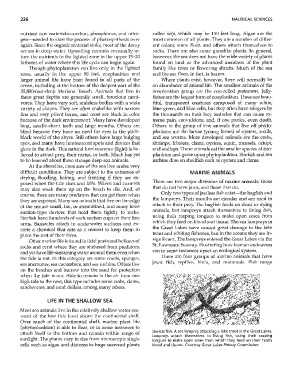
                                                                     Only two types of jawless fish exist-the hagfish and
          course, there are many predators that can get them when
                                                                 the lampreys. Their mouths are circular and are used to
          they are exposed. Many sea a:t1in1als that live on the edge
                                                                 attach to their prey. 111e hagfish feeds on dead or dying
          of the sea are small, flat, or sh'eamlined, and Inany have
                                                                 a:t1in1als,  but lampreys attach  themselves to living fish,
          suction-type  devices  that  hold  them  tightly  to  rocks.
                                                                 using  their  rasping  tongues  to  make  open sores  from
          Starfish have htmdreds of such suction cups on their five
                                                                 which they feed on blood and tissue. The sea lampreys in
          arms.  Barnacles  attach  to  underwater  slufaces  and  ex-
                                                                 the Great Lakes have caused great damage to  the lake
          crete a  chemical that acts as  a  cement to  keep  them in
                                                                 trout and whiting fisheries, but in the oceans they are in-
          place the rest of their lives.
                                                                 significant. The lampreys entered the Great Lakes via the
             Other marine life is found in tidal pools and hollows of
                                                                 St. Lawrence Sea\va)~ illustrating hm.v hmnan endeavors
          rocks and coral where they are sheltered from  predators,
                                                                 can in some instances upset an ecological system.
          and yet have life-sustaining water around them even ·when
                                                                     There are four  groups of marine animals  that have
          the tide is out. In this category are some corals, sponges,
                                                                 jaws:  fish,  reptiles,  birds,  and  mammals.  Fish  range
          sea anemones, sea cuclunbers, and sea urchins. Others live
          on  the beaches  and bmrow into  the sa:t1d  for  protection
          when the tide is out. Able to remain in the air from  one
          high tide to the next, this type includes some crabs, clams,
          sandworms, and sand dollars, among nlany others.
                     LIFE  IN THE  SHALLOW SEA
          Most sea animals live in the relatively shallo,v V\Tater sea-
          ward of the low  tide level  above  the continental shelf.
          Over  much  of  the  continental  shelf,  marine  plant life
          (phytoplankton) is able to float, or in some insta:t1ces to
                                                                 Jawless fish. A sea lamprey attacking a lake trout in the Great Lakes.
          attach itself to  the bottom  and remain within  range  of
                                                                 Lampreys  attach  themselves  to  living  fish,  using  their  rasping
          sunlight. The plants vary in size from microscopic single   tongues to  make  open sores from  which  they feed on their host's
          cells such as algae and diatoms to huge seaweed plants   blood and tissues.  Courtesy Great Lakes Fishery Commission

