


Page 234 - NS-2 Textbook
P. 234
OCEANOGRAPHY                                                                                         229


           Unlike baleen whales, toothed whales have teeth after
       birth. TI,ese teeth number from just a few in some species
        to as many as 250, although some may be concealed be-
        neath the gum. The narwhal has a single long, tusklike
        tooth in the upper jaw. Toothed whales have one blow-
        hole,  in  contrast  to  the  baleen,  which  have  two.  This
        group includes the animals commonly called dolphins or
       porpoises, as well as sperm whales. The sizes in this class
        range from the porpoise, which is about 5 feet long, to
        the sperm whale, which is up to 68-70 feet long. TIley eat
        fish prinlarily, but the sperm whale also likes giant squid
        found  at great depths.  Records  of sperm whales being
        entangled with submarine cables at depths to 3,700 feet
        indicate that some of the squid on which they feed  are
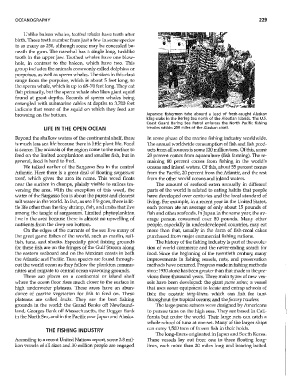
       browsing on the bottom.                                Japanese  fishermen  take  aboard  a  load  of  fresh-caught  Alaskan
                                                               king crabs  in the Bering Sea  north of the Aleutian Islands.  The  U.S.
                                                              Coast  Guard  Bering  Sea  Patrol  enforces  the  North  Pacific  fishing
                    LIFE  IN THE  OPEN  OCEAN                 treaties within 200 miles of the Alaskan coast.

        Beyond the shallow waters of the continental shelf, there   in some phase of the marine fishing industry worldwide.
        is much less sea life because there is little plant life. Food   The armual worldwide consumption of fish and fish prod-
        is scarce. The animals of the region come to the surface to   ucts from all sources is some 120 million tons. Of this, some
       feed on the limited zooplankton and smaller fish, but in   20 percent comes from aquaculture (fish farming). The re-
        general, food is hard to find.                         maining  80  percent  comes  from  fishing  in  the  world's
           We  talked earlier of the Sargasso Sea in the central   oceans and inland waters. Of this, about 55 percent comes
       Atlantic. Here there is a great deal of floating salgasslll1l   from fue Pacific, 20 percent from the Atlantic, and fue rest
        weed,  which gives  the  area  its  name.  This  weed  floats   from fue other world oceans and inland waters.
       near the surface in clumps, plainly visible to sailors tra-  The  amount of seafood eaten armually in different
       versing  the  area.  With  the  exception  of this  weed,  the   parts of the world is related to eating habits that people
        water of the Sargasso Sea is about the purest and clearest   have developed over centuries and the local standard of
        salt water in the world. In fact, as sea life goes, there is lit-  living. For example, in a recent year in the United States,
        tle life other than the tiny shrinlp, fish, and crabs that live   each person ate an average of only about 15 pOlU1ds  of
        among the tangle of sargassum. Limited phytoplankton   fish and other seafoods. In Japan in the same year, the av-
       live in the area because there is almost no upwelling of   erage  person  consumed  over  80  pounds.  Many  other
       nutrients from the deep sea bottom.                     people, especially in underdeveloped countries, may eat
           On the edges of the currents of the sea live many of   more than that,  usually in the form  of fish-meal  cakes
        the great game fishes of the world, such as marlin, sail-  purchased from major commercial fishing nations.
        fish,  tuna, and sharks. Especially good fishing grounds   The history of fue fishing industry is part of fue evolu-
        for these fish are on the fringes of the Gulf Stream along   tion of world commerce and the never-ending searm for
        the eastern seaboard and on the Mexican coasts in both   food.  Since the beginning of fue  twentieth cenhuy, many
        the Atlantic and Pacific. Tuna species are found through-  inlprovements  in  fishing  vessels,  nets,  and  preservation
       out the world ocean as they follow the plankton commu-  methods have occurred. Progress made in fishing methods
       nities and migrate to central ocean spawning grounds.   since 1930 alone has been greater than that made in the pre-
           TI,ere  are  places  on  a  continental  01'  island  shelf   vious three thousand years. TIrree main types of new ves-
        where the ocean floor rises much closer to the surface in   sels have been developed: the giant plIl'se seiner,  a vessel
       high  lU1derwater  plateaus.  These  areas  have  an  abun-  that uses sonar equipment to locate and entrap schools of
        dance  of  marine  vegetation for  fish  to  feed  on.  TI,ese   fish;  the  oceanic  IOllg-lillers,  which  can  fish  for  tuna
       plateaus  are  called  banks.  TIley  are  the  best  fishing   tluoughout the tropical oceans; and fue jac/ory trawlers.
        grounds in the world:  the Grand Banks off Newfollild-    The large purse seiners were designed by Americans
        land, Georges Bank off Massachusetts, the Dogger Bank   to pursue tuna on the high seas. They are based in Cali-
        in the North Sea, and in the Pacific near Japan and Alaska.   fornia but cruise the world. Their large nets can catch a
                                                               whole school of tuna at one set. Many of the larger ships
                                                               can carry 1,500 tons of frozen fish in their holds.
                    THE  FISHING  INDUSTRY
                                                                  The long-liners originated in Japan and South Korea.
       According to a recent United Nations report, some 3.8 mil-  These  vessels  layout from  one to  three  floating  long-
       lion vessels of all sizes and 30 million people are engaged   lines, each more than 20  miles long and bearing baited

