


Page 230 - NS-2 Textbook
P. 230
OCEANOGRAPHY                                                                                          225

       sea  life  in the  area  off  western  South America  ,vas re-   THE  FOOD CYCLE  IN THE  SEA
       duced  by  about 20  percent.  Severe  flooding  occurred
       across  South America  and  the  southern United  States,   Life  in  the  ocean  may  answer  many  of  the  questions
                                                              about the origin of life and its historical past, as well as
       and Australia and parts of the central United States ex-
                                                              help solve the problems of in1proving human life in the
       perienced hotter conditions and severe drought.
          A related effect called La Nilia  ("little girl" in Span-  future. The life cycle in the sea is of great in1portance to
                                                              everyone.  Marine  biologists  are  the  scientists  who  are
       ish) usually follows when the El Nifio subsides. The La
                                                              working to find the answers to some of these questions.
       Nifta effect results m lillusually cold surface waters in the
       Equatorial Pacific. Resulting global climate changes tend   111e life cycle is the chain of nahrral events in which
                                                              organic plants and anin1als take in foods and chemicals,
       to be opposite those associated with El Nifio. In the con-
                                                              release wastes dming their  lifetin1es,  and then die  and
       tmental  United  States,  durmg  El  Nino  years  tempera-
       tures m the winter are warmer than normal m the North   decompose. Bacterial, current, wave, and solar (Sun) en-
                                                              ergy  rotate  this  material  from  the  bottom  of  the  sea
       Central States and cooler than normal m  the Southeast
                                                              bringing it back into  the slmlight where the  process of
       and the Southwest. Durmg a La Nina year, wmter tem-
       perahu'es are warmer than normal in the Southeast and   photosynthesis regenerates new life.
                                                                  In the sea, as on land, swllight supports the life cycle.
       cooler than normal in the Northwest.
                                                              It does so through the process of photosy"thesis, the man-
          The  Red  Tide  al1d  Black  Sea.  In  the  Red  Sea,  atmo-
       spheric and sea conditions similar to El Nifio occasionally   ufachrre  of  food  in  a  green  plant.  In  the  sea,  floating
                                                              chlorophyll-bearing  (green-colored)  phytoplankton  are
       occur. There, when the upwelling of cool water stops, the
                                                              the basic  food  producers  of  the  sea.  They  provide  the
       surface layers become heated and bring about a popula-
                                                              proteins}  starches,  and  sugars  necessary  to  support
       tion  explosion  (or  bloom)  of  tiny  red-colored  phyto-
                                                              the  sea's  smallest life.  Phytoplankton are  the  food  for
       plankton called dil1oflagellata.  111ey become so munerous
                                                              the zooplankton, tiny animals of many shapes, which are
       that the water takes on a reddish colm; giving it the name
       Red Tide (and giving the Red Sea its name). The Red Tide   either free-floating or self-propelled. The zooplankton-
                                                              which  also include  the eggs and larvae of some larger
       clogs  the  gills  of  fish,  causing  them  to  suffocate  and
                                                              fishes-are the food for small flesh-eaters (carnivores) of
       die. Millions of dead fish are washed ashore, and the re-
                                                              the  ocean.  In hu'n,  the  small  carnivores  are  eaten  by
       sulting stench carries  for  miles.  A similar event ocelli'S,
                                                              larger ones. Death and decay complete the cycle. 11,e or-
       more rarely, along the east coast of Florida. Some years
                                                              ganic material of both plants and anin1als decays as the
       ago,  many  resorts  and  bathing  beaches  had  to  close
                                                              result  of  bacterial  action,  thereby  releasing  again  the
       down lmtil the Red Tide passed and the dead fish were
       cleared away.
          The  Black  Sea  is  essentially  a  very large  saltwater
       lake.  Its  only  opening  is  through  the  Tmkish  straits
       (Bosporus  and  Dardanelles)  to  the  Aegean  Sea.  The
       straits  are  very  shallow,  so  there  is  little  exchange  of
       'water behveen the hvo seas, and no chance for up,velling
       or the introduction of dissolved oxygen in the Black Sea.
       As a result, the Black Sea is stagnant. The residue of ma-
       rine life in the smface layers sinks to the bottom and re-
       mains there to decay.
          The decay of animal  and vegetable matter uses up
       whatever oxygen is available and creates hydrogen sul-
       fide  gas.  Over thousands of years, this gas and lack of
       oxygen  have  completely  destroyed  bottom  life  m  the
       Black Sea.  The hydrogen sulfide layer begins about 200
       feet below the surface and continues to the bottom. There
       is no life in this J'black zone," which has given its name
       to the sea.
          For navies,  the  Black Sea poses a  special  problem.
       Hydrogen sulfide gas, 'when mixed with 'vater, has a COf-
       rosive effect on metals. Recall the Callao  Pail1ter  turning
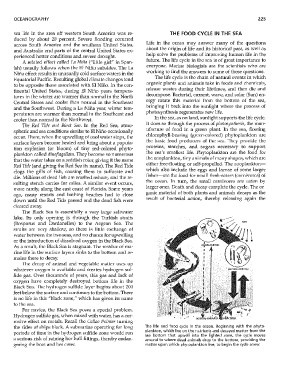
       the sides of ships black. A submarine operating for long   The  life  and  food  cycle  in  the  ocean.  Beginning  with  the  phyto-
                                                              plankton, which  live on the nutrients and decayed matter from the
       periods of time in the hydrogen sulfide zone would run
                                                              sea  bottom  that  upwell  into  the  lighted  zone,  the  cycle  moves
       a serious risk of ruining her hull fittings, thereby endan-  around to where dead animals  drop to the bottom,  providing the
       gering the boat and her crew.                          matter upon which phytoplankton live,  to begin the cycle anew.

