


Page 295 - NS-2 Textbook
P. 295
290                                                                                      NAUTICAL SCIENCES

             Many smaller craters are ahnost certainly the result
         of  early  volcanic  activity,  as  gases  and  dusts  escaped
         from the Moon's interior. Some of these can be compared
         to volcanic craters on Earth, formed when the surface of
         the Earth collapses into an underlying cavity from which
         lava has flowed. (Often a central peak remains in the cen-
         ter  of  such  craters-for example,  the  island  in Crater
         Lake, Oregon.)
             The most conspicuous crater is Tycho, in the Moon's
         southern hemisphere. It is easily seen when the Moon is
         full.  Tycho has a great system of rays, which radiate as
         far  as 1,500 miles out from  the edges of the crater. The
         crater Copernicus has a similar system. Rays are thought
         to be fine surface material that was splattered out of the
         most  recent  impact  craters  when  they  were  formed.
         Some rays are chains of small craters, created by the ex-
         plosive ejection of material during the formation of the
         main crater.
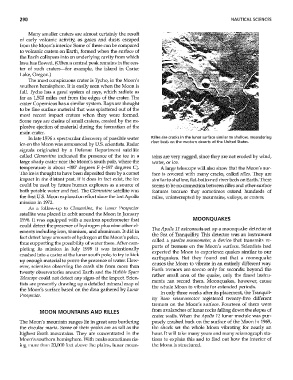
             1n late 1996 a spectacular discovery of possible water   Rilles are cracks  in the lunar surface similar to shallow,  meandering
                                                                river beds on the western deserts of the United States.
         ice on the Moon was announced by U.S. scientists. Radar
         signals  originated  by  a  Defense  Department  satellite
         called Clementine  indicated the presence of the ice  in  a   tains are very rugged, since they are not eroded by wind,
         large shady crater near the Moon's south pole, where the   water, or ice.
         temperature is  about -387 degrees F  (-197 degrees C).    A large telescope will also show that the Moon's sur-
         The ice is thought to have been deposited there by a comet   face  is  covered with many cracks, called rilles.  They are
         impact in the distant past. If it does in fact exist, the ice   similar to shallow, flat-bottomed river beds on Earth. There
         could be used by fuhrre human explorers as a source of   seems to be no connection between rilles and other surface
         both potable water and fuel. The Clementine satellite was   features  because  they  sometimes  extend  hundreds  of
         the first U.s. Moon exploration effort since the last Apollo   miles, uninterrupted by mountains} valleys, or craters.
         mission in 1972.
             As  a  follow-up  to  Clementine,  the  LlInar  Prospector
         satellite was placed in orbit around the Moon in January
         1998. It was equipped with a neutron spectrometer that                   MOON QUAKES
         could detect the presence of hydrogen plus nine other el-
                                                                The Apollo 11  astronauts set up a moonquake detector at
         ements including iron, titanium, and ahuninum. It did in
                                                                 the Sea of Tranquility. This detector was an instrument
         fact detect large amounts of hydrogen at the Moon's poles,
                                                                called a  passive  seismol1lete)~ a  device  that transmits re-
         thus supporting the possibility of water there. After com-
                                                                ports of tremors  on the Moon's surface.  Scientists had
         pleting  its  mission  in  July  1999  it  was  intentionally
                                                                expected the Moon to experience quakes similar to our
         crashed into a crater at the lunar south pole, to try to kick
                                                                earthquakes.  But  they  found  out  that  a  moonquake
         up enough material to prove the presence of water. How-
                                                                causes the Moon to vibrate in an entirely different way.
         evel~ scientists observing the crash  site from  more  than
         twenty observatories around Earth and the HlIbble  Space   Earth tremors are  severe  only for  seconds: beyond the
                                                                rather small area of  the  quake,  only the  finest  instru-
         Telescope could not detect any signs of the impact. Scien-
                                                                ments  can record  them.  Moonquakes,  however,  cause
         tists are presently drawing up a detailed mineral map of
                                                                the whole Moon to vibrate for extended periods.
         the Moon's surface based on the data gathered by LlInar
                                                                    In only three weeks after its placement, the Tranquil-
         Prospector.
                                                                ity  Base  seismometer  registered  twenty-five  different
                                                                tremors  on the  Moon's surface.  Fourteen of them  were
                                                                from avalanches of lunar rocks falling down the slopes of
                  MOON MOUNTAINS AND RILLES
                                                                crater walls. When the Apollo 12 lunar module was pur-
         The Moon's mountain ranges lie in great arcs bordering   posely crashed back on the surface of the Moon in 1969,
         the circular maria. Some of their peaks are as tall as the   the  shock set  the  whole Moon vibrating for  nearly an
         highest Earth mountains.  They are concentrated in  the   hour. It will take many years and many seismograph sta-
         Moon's southern hemisphere. With peaks sometimes ris-  tions to explain this and to find out how the interior of
         ing more than 20,000 feet above the plains, lunar moun-  the Moon is struchued.

