


Page 313 - NS-2 Textbook
P. 313
308                                                                                     NAUTICAL SCIENCES


                                                                 what seemed to be a system of rings in the space between
                                                                 the planet and its five larger moons.
                                                                    Voyager 2 flew by Uranus on 24 January 1986 and ver-
                                                                 ified the presence of the rings. It assessed them as com-
                                                                 posed of small gravel-like rocks and stones. It also dis-
                                                                 covered  ten  small  moons,  unobsen'able  from  Earth.
                                                                 Another significant discovery about the planet was that
                                                                 its magnetic axis is inclined about 65 degrees with respect
                                                                 to  its  spin axis,  which  was  thought to  make  it  unique
                                                                 among the  planets  of our solar system  until Voyager  2
                                                                 found a similar situation at Neptune in 1989.


                                                                                     NEPTUNE

                                                                 Uranus and Neptune are  often called  the  twin planets,
                                                                 even though the latter is more than 1 billion miles farther
                                                                 from the Sun. They are similar, though, in size (roughly
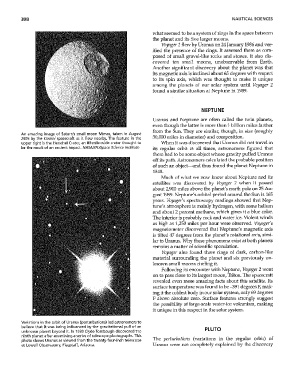
          An  amazing  image  of Saturn's  small  moon  Mimas,  taken  in  August
          2005  by  the Cassin; spacecraft  as  it flew  nearby.  The  feature  in  the   30,000 miles in diameter) and composition.
          upper right is the Herschel Crater, an  88-mile-wide crater thought to   When it was discovered that Uranus did not travel in
          be the result of an ancient impact. NASAfJPLlSpace Science Institute   its  regular  orbit  at  all  times,  astronomers figured  that
                                                                 there had to be some object whose gravity pulled Uranus
                                                                 off its path. Astronomers calculated the probable position
                                                                 of such an object-and thus found the planet Neptune in
                                                                 1848.
                                                                    Much of what we now know about Neptune and its
                                                                 satellites  was  discovered  by  Voyager  2  when  it  passed
                                                                 about 2,900 miles above the planet's north pole on 25 Au-
                                                                 gust 1989. Neptune's orbital period around the Sun is 165
                                                                 years. Voyagers  spectroscopy readings showed that Nep-
                                                                 tune's atmosphere is mainly hydrogen, with some helium
                                                                 and about 2 percent methane, which gives it a blue color.
                                                                 The interior is probably rock and water ice. Violent winds
                                                                 as high as 1,250 miles per hour were observed. Voyager's
                                                                 magnetometer discovered that Neptune's magnetic axis
                                                                 is tilted 47 degrees from the planet's rotational axis, simi-
                                                                 lar to Uranus. Why these phenomena exist at both planets
                                                                 remains a matter of scientific speculation.
                                                                    Voyager  also  found  three  rings  of  dark,  carbon-like
                                                                 material surrounding the planet and six previously un-
                                                                 known small moons circling it.
                                                                    Following its encounter with Neptune, Voyager 2 went
                                                                 on to pass close to its largest moon, Triton. The spacecraft
                                                                 revealed even more amazing facts  about this satellite. Its
                                                                 surface temperahlre was found to be -391 degrees F, mak-
                                                                 ing it the coldest body in our solar system, only 69 degrees
                                                                 F above absolute zero. Surface features strongly suggest
                                                                 the possibility of large-scale water-ice volcanism, making
                                                                 it unique in this respect in the solar system.


          Variations in the orbit of Uranus (perturbations) led astronomers to
          believe that it was being influenced by the gravitational  pull  of an
          unknown planet beyond it. In  1930 Clyde Tombaugh discovered the             PLUTO
          ninth planet after examining a series of telescope photographs. This
          photo shows Uranus as viewed from the twenty-four-inch telescope   The  pertllrbations  (variations  in  the  regular  orbit)  of
          at lowell Observatory,  Flagstaff,  Arizona.           Uranus were not completely explained by the discovery

