


Page 308 - NS-2 Textbook
P. 308
ASTRONOMY                                                                                             303


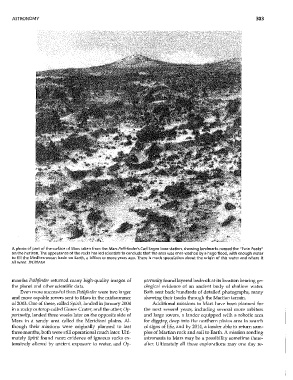
      A photo of part of the surface of Mars taken from the Mars Pathfinder's Carl Sagan base station, showing landmarks named the "Twin Peaks"
      on the horizon. The appearance of the rocks has led scientists to conclude that the area was once washed by a huge flood, with enough water
      to fill  the Mediterranean basin  on  Earth,  a billion  or more years  ago. There is  much speculation about the origin  of this water and where it
      all went. JPL/NASA


      months Pathfi11der returned many high-quality images of   portll11ity found layered bedrock at its location bearing ge-
      the planet and other scientific data.                  ological  evidence  of an ancient body of shallow water.
          Even more successful than Pathfi11der were two larger   Both sent back hundreds of detailed photographs, many
      and more capable rovers sent to Mars in the midsummer   showing their tracks through the Martian terrain.
      of 2003. One of these, called Spirit, landed in Januaty 2004   Additional missions to Mars have been planned for
      in a rocky outcrop called Gusev Crater, and the other, Op-  the  next  several  years,  including  several  more  orbiters
      portll11ity, landed three weeks later on the opposite side of   and large rovers, a lander equipped with a robotic arm
      Mars  in  a  sandy  area  called  the  Meridiani  plains.  Al-  for digging deep into the northern plains area in search
      though  their  missions  were  originally  plmmed  to  last   of signs of life, and by 2014, a lander able to return sam-
      tlu·ee months, both were still operational much later. Ulti-  ples of Martian rock and soil to Earth. A mission sending
      mately Spirit  found more evidence of igneous rocks ex-  astronauts to Mars may be a possibility sometime there-
      tensively altered by ancient exposure to watel; and Op-  after. Ultimately all  these explorations may one day re-

