


Page 312 - NS-2 Textbook
P. 312
ASTRONOMY                                                                                             307


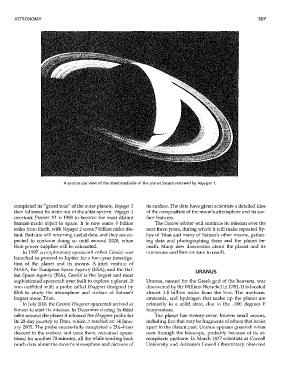
                            A spectacular view of the shadowed side of the planet Saturn  returned by Voyager 1.


       completed its" grand tour" of the outer planets, Voyager 2   its surface. The data have given scientists a detailed idea
       then followed its sister out of the solar system. Voyager 1   of the composition of the moon's atmosphere and its sur-
       overtook Pioneer 10 in 1998  to become the most distant   face features.
       human-made  object in  space.  It is now some  9 billion   The Cassil1i orbiter will continue its mission over the
       miles from Earth, with Voyager 2 some 7 billion miles dis-  next three years, during which it will make repeated fly-
       tant. Both are still retuming useful data, and they are ex-  bys of Titan and many of Satum's other moons, gather-
       pected  to  continue  doing  so  until  around  2020,  when   ing  data  and photographing  them  and  the  planet be-
       their power supplies will be exhausted.                neath.  Many new discoveries  about the  planet and its
           In 1997 an exploratory spacecraft called Cassini was   nunlerous satellites are sure to result.
       launched to proceed to Jupiter for a four-year investiga-
       tion  of  the  planet  and  its  moons.  A  joint  venture  of
       NASA, the European Space Agency (ESA), and the Ital-                        URANUS
       ian Space Agency  (ISA),  Cassini is the largest and most
       sophisticated spacecraft ever built to explore a planet. It   Uranus, named for the Greek god of the heavens, was
       was outfitted with a probe called HlIygt1ls  designed by   discovered by Sir William Herschel in 1781. It is located
       ESA  to  study  the  atmosphere  and  surface  of  Sahrrn's   almost  1.8  billion  miles  from  the  Sun.  The  methane,
       largest moon Titan.                                    ammonia, and hydrogen that make up the planet are
           In July 2004 the Cassini-HlIygens spacecraft arrived at   primarily in a  solid  state,  due  to  the  -300  degrees  F
       Sahrrn to start its mission. In December during its third   temperature.
       orbit around the planet it released the HlIygens probe for   The  planet  has  twenty-seven  known  small moons,
       its 20-day journey to Titan, which it reached on 14 Janu-  including five that may be fragments of others that broke
                                                  1
       ary 2005.  The probe successfully completed a 2 h-hotIr   apart in the distant past. Uranus appears greenish when
       descent to  the surface, and once there, relnained opera-  seen through  the telescope, probably because of its  at-
       tional for another 70 minutes, all the while sending back   mospheric methane. In March 1977 scientists at Cornell
       much data about the moon's atmosphere and pictures of   University and Arizona's Lowell Observatory observed

