


Page 310 - NS-2 Textbook
P. 310
ASTRONOMY                                                                                             305


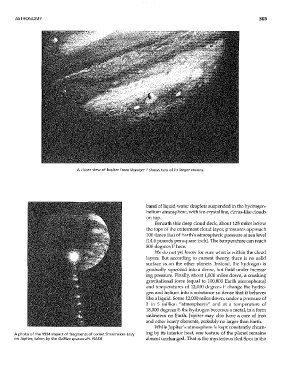
                                 A  closer view of Jupiter from Voyager 1 shows two of its  larger moons.


                                                              band of liquid-water droplets suspended in the hydrogen-
                                                              helium atmosphere, with ice-crystalline, cirrus-like clouds
                                                              on top.
                                                                  Beneath this deep cloud deck, about 125 miles below
                                                              the tops of the outermost cloud layer, pressures approach
                                                              100 times that of Earth's atmospheric pressure at sea level
                                                              (14.6 pOlmds per square inch). The temperature can reach
                                                              800 degrees F here.
                                                                  We do not yet know for sure what is within the cloud
                                                              layers.  But according to current theory,  there is no solid
                                                              surface as on the other planets. Instead, the hydrogen is
                                                              gradually squeezed into a dense, hot fluid Imder increas-
                                                              ing pressure. Finally, about 1,800 miles down, a crushing
                                                              gravitational force  (equal to 100,000  Earth atmospheres)
                                                              and temperatures of 12,000 degrees F change the hydro-
                                                              gen and helium into a substance so dense that it behaves
                                                              like a liquid. Some 12,000 miles down, under a pressure of
                                                              3  to  5  million  "atmospheres"  and  at  a  tempera hIre  of
                                                              18,000 degrees F, the hydrogen becomes a metal, in a form
                                                              unknown on Earth. Jupiter may also have a core of iron
                                                              and other heavy elements, probably no larger than Earth.
                                                                  While Jupiter's atmosphere is kept constantly churn-
       A photo of the 1994 impact of fragments of comet Shoemaker-levy   ing by its interior heat, one feature of the planet remains
       on Jupiter,  taken by the Galilee spacecraft. NASA     almost unchanged. That is the mysterious Red Spot in the

