


Page 309 - NS-2 Textbook
P. 309
304                                                                                     NAUTICAL SCIENCES


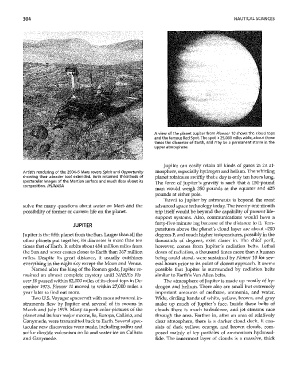
                                                                  A view of the planet Jupiter from Pioneer  10 shows the clOUd  tops
                                                                  and the famous Red Spot. The spot is 25,000 miles wide, about three
                                                                  times the diameter of Earth,  and may be a permanent storm  in the
                                                                  upper atmosphere.


                                                                      Jupiter can easily retain all kinds of gases in its at-
           Artist's rendering of the 2004-5 Mars  rovers Spirit and Opportunity   mosphere, especially hydrogen and helium. The whirling
           showing their abrader  tool extended.  Both  returned  thousands of   planet rotates so swiftly that a day is only ten hours long.
           spectacular images of the Martian surface and  much data about its   The force  of Jupiter's gravity is  such that a  ISO-pound
           composition. )PLlNASA
                                                                  man would weigh 350  pounds at the  equator and 425
                                                                  pounds at either pole.
                                                                      Travel to Jupiter by astronauts is beyond the  most
           solve the many questions about water on Mars and the   advanced space technology today. TIle twenty-one-month
           possibility of former or current life on the planet.   trip itself would be beyond the capability of present life-
                                                                  support  systems.  Also,  communications  would have  a
                                                                  forty-five-minute lag because of the distance to it. Tem-
                                JUPITER
                                                                  peratures above the planet's cloud layer are about -200
           Jupiter is the fifth planet from the Still. Larger than all the   degrees F, and much higher temperatures, possibly in the
           other planets put together, its diameter is more than ten   thousands  of  degrees,  exist  closer  in.  The  chief  peril,
           times that of Earth. It orbits about 484 million miles from   however,  comes  from  Jupiter's  radiation  belts.  Lethal
           the Sun and never comes closer to Earth than 367 million   doses of radiation, a thousand times more than a hrnnan
           miles.  Despite  its  great  distance,  it  usually  outshines   being could stand, were sustained by Pioneer 10 for sev-
           everything in the night sky except the Moon and Venus.   eral haUl'S prior to its point of closest approach. It seems
              Named after the king of the Roman gods, Jupiter re-  possible  that Jupiter  is  sUl'l'Olmded  by  radiation  belts
           mained an almost complete mystery until NASA's Pio-    sinillar to Earth's Van Allen belts.
           neer 10 passed within 82,000 miles of its cloud tops in De-  The atmosphere of Jupiter is made up mostly of hy-
           cember 1973. Pioneer 11  moved to within 27,000 miles a   drogen and helium. There also are small but extremely
           year later to find out more.                           important  amOlmts  of methane,  ammonia,  and  water.
               Two U.s. Voyager spacecraft with more advanced in-  Wide, circling bands of white, yellow, brown, and gray
           struments flew  by Jupiter  and  several of its  moons in   make up much of Jupiter's face.  Inside  these  belts  of
           March and July 1979. Many superb color pictUl'es of the   clouds  there  is  TIllieh  turbulence,  and jet  streams  race
           planet and its foUl' major moons, la, EUl'opa, Callisto, and   through the area. Farther in, after an area of relatively
           Ganymede, were transmitted back to Earth. Several spec-  clear ahnosphere,  there is a  darker cloud deck.  It con-
           tacular new discoveries were made, including sulfur and   sists  of  dark  yella,,,,,  orange,  and  brm.vn  clouds,  com-
           sulftu' dioxide vulcanism on 10 and V\'ater ice on Callisto   posed mainly of icy particles of anunonium hydl'Osul-
           and Ganymede.                                          fide.  The nmermost layer of clouds is a  massive, thick

