


Page 81 - NS-2 Textbook
P. 81
74                                                                                       MARITIME HISTORY


         ers sunle Von Spee then decided to proceed around the   had earlier broken the German naval code alld had gath-
         cape to Port Stanley in December, hoping to capture the   ered radio intelligence that tipped them off about the Ger-
         base and its coal supplies. TI,e British, however, had sent   man plans.  Under  the  command  of British  admiral Sir
         two additional cruisers to the Falklands to join six others   Jolm  Jellicoe  were about 150  ships, including 28  dread-
         already there, so ,vhen von Spee arrived on 8 December,   noughts and several squadrons of cruisers and destroyers.
         he  found  hinlself  oUhmmbered.  He  tried  to  flee  back   First contact was made at about 1530 the afternoon of
         west, but was overtaken and his ships were cut to pieces   31  May between  opposing  cruiser  forces.  Within  min-
         by the superior British force.  This battle eliminated the   utes,  two  British  cruisers  had  been  sunk  by  German
         last major German surface forces outside the North Sea.   cruisers, ·which  were superior in armor and armament.
                                                                But the main action was yet to come. At about 1650, a di-
                                                                 vision of four British dreadnoughts came into range with
                     GALLI POll AND JUTLAND
                                                                the German main body and began a nmning battle to the
         In late 1914  the British war command concluded  that if   north,  with Jellicoe's  main body of nventy-four battle-
         they could force the Dardanelles and capture Constantino-  ships proceeding to join the action from the northwest.
         ple, the Allies could then supply men and war materials   About 1800 a  long column of Jellicoe's battleships suc-
         through Russia to the eastern front, thereby ending the war   ceeded in "capping the T"  on Scheer's force.  (Capping
         in a matter of months. The key to this plan was to capture   the T is a classic naval tactic. A commander attempts to
         the Turkish peninsula of Gallipoli, which commanded the   malleUVer  his  column of warships into  position at the
         approaches to the Dardanelles and the Sea of Marmara.   head of a T with an enemy column moving up the stem
             Accordingly,  but  only  after  much delay,  which al-  of the  T.  This  gives his  ships full  broadside  capability
         lowed the Turkish defenders to reinforce and secure their   against the enemy ships while the enemy ships can bring
         positions, an amphibious assault was launched against   only their forward guns to bear.)  Before  they could do
         Gallipoli in late April 1915.  Because of a lack of experi-  much datnage, Scheel' turned away to disengage. Jellicoe
         ence, poor recomlaissance and bad planning, a lack of co-
         ordination,  and  ineffective  naval  gunfire  support,  the
         landings did not go well. Still, a sizable number of Allied
         troops V\Tere eventually landed. Ho,vever, they were soon
         deadlocked  in  position  by  an  equal  number  of  Turks
         under the aggressive command of Mustafa Kemal, who
         eight years later would found the Turkish Republic. The
         stalemate continued until November 1915,  when it be-
         came obvious that the campaign would not succeed. The
         Allied  forces  then began to  withdraw, completing this
         operation by Janualy 1916. Their successful withdrawal
         under fire  is still  considered  to be one of the most re-
         markable amphibious evacuations in the history of mod-
         ern warfare. As a result of the failed Gallipoli catnpaign,
         Bulgaria joined the Central Powers and helped GermallY
         conquer all of the Balkan cotmtries.
             In January 1916 a new, more aggressive admiral was
         given commalld of the German High Seas Fleet: Vice Ad-
         miral Reinllard Scheer. He was determined to do selective
         battle with the British fleet in order to reduce its numbers
         and perhaps win control of the North Sea. Accordingly, in
         May the fleet sortied from its base at Jade Bay and pro-
         ceeded  toward  the  coast  of  southern  Norway opposite
         Demnark's  Jutland  Peninsula  to  raid  Allied  shipping
         there. Altogether there were some 100 German ships, in-
         cluding  16  dreadnought  and  6  predreadnought  battle-
         ships and a lltilllber of cruisers and destroyers in scouting
         positions. Unknown to the German commandel~ hovv€ver,
         the British Grand Fleet had sailed  for  the satne area the
         day before from its bases at Scapa Flow and the Scottish
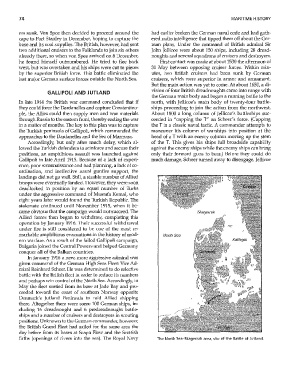
         firths  (openings of rivers into the sea).  The Royal  Navy   The North Sea-Skagerrak area,  site of the Battle of Jutland.

