


Page 84 - NS-2 Textbook
P. 84
WORLD WAR I                                                                                            77


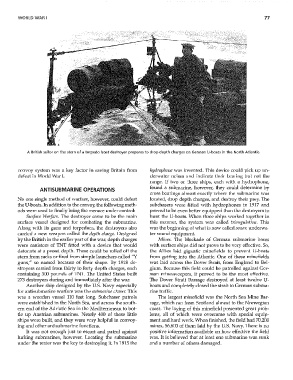
            A British  sailor on  the stern of a torpedo boat destroyer prepares to drop depth charges on German U-boats in the North Atlantic.


         convoy system was a key factor in saving Britain  from   hydropholle was invented. This device could pick up un-
         defeat in World War I.                                 derwater noises  and indicate  their bearing but not  the
                                                                range. If two  or  tlU'ee  ships,  each  with a  hydrophone,
                                                                found  a submarine, howevel;  they could determine by
                  ANTISUBMARINE  OPERATIONS
                                                                cross bearings almost exactly where the submarine was
        No one single method of warfare, however, could defeat   located, drop depth charges, and destroy their prey. TIle
         the U-boats. In addition to the convoy, the following meth-  subchasers  were  fitted  with hydrophones  in  1917  and
         ods were used to finally bring the menace under control:   proved to be even better equipped than the destroyers to
            Swface Warfare.  The destroyer came to be the main   hlmt the U-boats. When three ships worked together in
         smface  vessel  designed for  combating  the  submarine.   this  manner,  the  system was  called  triallgulatioll.  This
        Along with its guns and torpedoes, the destroyers also   was the beginning of what is nmv called sonar, tmderwa-
         carried a new weapon called the depth  charge.  Designed   ter sOlmd equipment.
        by the British in the earlier part of the Wat; depth charges   Milles.  The  blockade  of  German  submarine  bases
        were canisters of  TNT fitted  with a  device  that would   with surface ships did not prove to be very effective. So,
         detonate at a preset depth. These could be rolled off the   the  Allies  laid  gigantic  minefields  to  prevent  U-boats
         stern from racks or fired from simple launchers called "Y   from  getting into the Atlantic.  One of these  minefields
         guns,"  so  natned because  of  their  shape.  By  1918  de-  was laid across  the Dover Strait, from England to  Bel-
        stroyers carried from thirty to forty depth charges, each   gillln. Because this field could be patrolled against Ger-
        containing 300 pounds of TNT.  The United States built   man minesweepers, it proved to be the  most effective.
        273 destroyers dming and immediately after the Wat·.    The  Dover Strait  Barrage  destroyed  at least  twelve U-
            Another ship designed by the U.S.  Navy especially   boats and completely closed the strait to German subma-
        for antisubmarine warfare ,"vas the submarine chaser. This   rine traffic.
        was  a  wooden vessel  110  feet  long.  Subchaser  patrols   The largest minefield was the North Sea Mine Bar-
        were established in the North Sea, and across the south-  rage, which ran from Scotland almost to the Norwegian
        ern end of the Adriatic Sea in the Mediterranean to bot-  coast. The laying of this minefield presented great prob-
        tle  up Austriatl  submarines.  Nearly 400  of these  little   lems,  all  of which  V\rere  overcome  with  special  equip-
        ships were built, and they were very helpful in convoy-  ment and hard work. When finished, the field had 70,200
        ing and other antisubmarine nmctions.                   mines, 56,600 of them laid by the U.S. Navy. There is no
            It was not enough just to escort and patrol against   positive information available on how effective the field
        lmking  submarines,  however.  Locating  the  submarine   was. It is believed that at least one submarine was sunk
         under the water was the key to destroying it. In 1915 the   and a nmnber of others damaged.

