


Page 85 - NS-2 Textbook
P. 85
78                                                                                      MARITIME  HISTORY


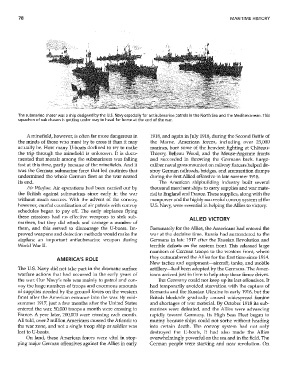
         The submarine chaser was a ship designed by the U.S.  Navy especially for antisubmarine patrols in the North Sea and the Mediterranean. This
         squadron  of sub chasers is getting under way to head for home at the end of the war.


            A minefield, however, is often far more dangerous in   1918, and again in July 1918, during the Second Baltle of
         the minds of those who must try to cross it than it may   the  Marne.  American  forces,  including  over  25,000
         actually be. How many V-boats declined to try to make   marines, bore some of the heaviest fighting at Chateau-
         the  trip  through the minefield is  unknown.  It is  docu-  Thierry,  Belleau  Wood,  and  the  Meuse-Argorme  fronts
         mented that morale among the submariners was falling   and  succeeded in  throwing  the  Germans  back.  Large-
         fast at this time, partly because of the minefields. And it   caliber naval guns mounted on railway flatcars helped de-
         was the German submarine force  that led mutinies that   stroy German railroads, bridges, and mnmunition dumps
         undermined the whole German fleet as the war neared    during the first Allied offensive in late summer 1918.
         its end.                                                  The  American  shipbuilding  industry  built  several
            Ail' Waif are.  Air operations had been carried out by   thousand merchant ships to carry supplies and war mate-
         the  British  against  submarines  since  early  in  the  war   rial to England and France. These supplies, along with the
         vdthout lunch  success.  With  the  advent of the  convoy,   manpower and the highiy successful convoy system of the
         however, careful coordination of air patrols with convoy   v.s. Navy, were essential in helping the Allies to victory.
         schedules  began to  payoff. The  early airplanes  flying
         these  missions  had  no  effective  "weapons  to  sink  sub-          ALLIED  VICTORY
         marines, but they did attack and damage a  number of
         them,  and  this  served  to  discourage  the  V-boats.  Im-  Forttmately for the Allies, the Americans had entered the
         proved weapons and detection methods would make the    war at the decisive time. Russia had surrendered to the
         airplane  an  important  antisubmarine  weapon  during   Germans in late 1917 after the Russian Revolution and
        World War II.                                           terrible defeats on the eastern front. This released large
                                                                nUlnbers of Gernlan troops  to  the western front/ ,,\There
                                                                they outnumbered the Allies for the first time since 1914.
                         AMERICA'S  ROLE
                                                                New tactics and equipment-aircraft, tanks, and mobile
         The U.S. Navy did not take part in the dramatic surface   artillery-had been adopted by the Germans. The Amer-
         warfare actions  that had occurred  in  the early years of   icans arrived just in time to help stop these fierce drives.
         the war. Our Navy's role was mainly to patrol and con-    But Germany could not keep up its last offensives. It
         voy the huge numbers of troops and enormous amOlmts    had temporarily avoided starvation with the capture of
         of supplies needed by the ground forces on the western   Romania and the Russian Ukraine in early 1916, but the
         front after the American entrance into the war. By mid-  British  blockade  gradually  caused  widespread  famine
         summer 1917, just a few months after the Vnited States   and shortages of war material. By October 1918 its sub-
         entered the Wat; 50,000 troops a month were crossing to   marines ,,\Tere  defeated/  and  the  Allies ,"vere  advancing
        France. A year later, 200,000 were crossing each month.   rapidly  toward Germany.  Its  High Seas Fleet began to
        All told, over 2 million Americans crossed the Atlantic to   mutiny because ships could not sortie without heading
         the war zone, and not a single troop ship or soldier ,vas   into  certain  death.  The  convoy  system  had  not  only
        lost to V-boats.                                        destroyed  the  V-boats,  it  had  also  made  the  Allies
            On land/  these  American  forces  ,vere vital  in stop-  ovelwhelmingly powerful on the sea and in the field. The
        ping major German offensives against the Allies in early   German people ·were  starving and  near  revolution.  On

