


Page 89 - NS-2 Textbook
P. 89
82                                                                                      MARITIME HISTORY

         warships  to  35  percent  of  British  tonnage,  and  sub-
         marines to 45 percent. Also in 1935 the Italians invaded
         Ethiopia, annexing that country in 1936 and renaming it
         Italian  East  Africa.  When  the  League  of  Nations  de-
         nounced that act as "bald aggression" and imposed some
         economic sanctions, Italy purchased war supplies from
         Germany, withdrew from the league, and with Germany
         formed the Rome-Berlin Axis.
            In early  1939  Hitler  abolished  the  Anglo-German
         naval  limitation agreement,  freeing  Germany  to  begin
         building as many warships of whatever kind and ton-
         nage it wanted. By the time war broke out in September
         1939,  when  Hitler  invaded  Poland,  the  German Navy
         consisted of  two 31,000-ton battleships,  two 42,000-ton
         battleships nearing completion (the Tirpitz and Bismarck),
         three 20,000-ton pocket battleships, nine cruisers, a nwn-
         bel'  of  destroyers,  and  fifty-six  submarines.  Germany
         continued to build U-boats throughout the war at a furi-
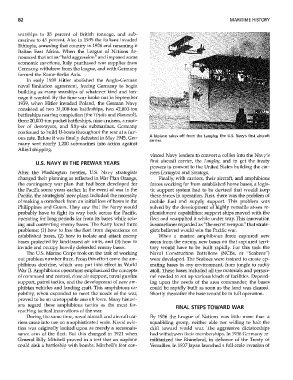
         ous rate. Before it was finally defeated in May 1945, Ger-  A  biplane takes off from  the Langley,  the  U.S.  Navy's  first  aircraft
                                                                carrier.
         many sent nearly 1,200  submarines into  action  against
         Allied shipping.
                                                                vinced Navy leaders to convert a collier into the Navy's
                                                                first  aircraft  carriel;  the  Langley,  and  to  get the  treaty
                U.S.  NAVY IN THE  PREWAR YEARS
                                                                powers to consent to the United States building the car-
         After  the  Washington  treaties,  U.s.  Navy  strategists   riers Lexington and Saratoga.
         changed their planning as reflected in War Plan Orange,    Finally, with carriers, their aircraft, and amphibious
         the  contingency war plan that had been developed for   forces working far from established home bases, a logis-
         the Pacific some years earlier. In the event of war in the   tic  support system had to be devised  that would keep
         Pacific, the strategists' new plans included the necessity   these forces in operation. First, there was the problem of
         of making a comeback from an initial loss of bases in the   mobile  fuel  and  supply  support.  TIlis  problem  was
         Philippines and Guam. TIley saw that the Navy would    solved by the development of highly versatile at-sea re-
         probably have to  fight  its way back  across  the Pacific,   plenishment capabilities: support ships moved with the
         operating for long periods far from its bases while seiz-  fleet and resupplied it while under way. This innovation
                                                                                                       u
         ing and converting enemy bases. The Navy faced  three   is sometilnes regarded as lithe secret weapon that strate-
         problems: (1)  how to free  the fleet from  dependence on   gists believed would win the Pacific war.
         established bases,  (2)  how to  isolate and attack enemy   When  a  marine  amphibious  force  captured  new
         bases protected by land-based air tmits, and (3) how to   areas from the enemy, new bases on that captured terri-
         invade and occupy heavily defended enemy bases.        tory  would have  to  be built rapidly.  For  this  task  the
            TI,e u.s. Marine Corps took on the task of working   Naval  Construction  Battalions  (NCBs,  or  "Seabees")
         out problem number three. From this effort came the am-  were developed. The Seabees were trained to create op-
         phibious doctrine, which was put into effect in World   erating bases in any environment, from jungle to rocky
         War II. Amphibious operations emphasized the concepts   atoll. These bases included all the materials and person-
         of command and control, close air support, naval gwlfire   nel needed to set up various kinds of facilities.  Depend-
         support, patrol tactics, and the development of new am-  ing upon the  needs  of the  area  commander,  the  bases
         phibian vehicles and landing craft. TIlis amphibious ca-  could be rapidly built as soon as the land was cleared.
         pability, when expanded to meet the needs of the war,   Shortly thereafter the base would be in full operation.
         proved to be an unstoppable assault force. Many histori-
         ans  regard  these  amphibious  tactics  as  the  most  far-
                                                                           FINAL STEPS TOWARD WAR
         reaching tactical ilUl0vations of the vvar.
            During the same time, naval aircraft and aircraft car-  By  1936  the  League  of Nations  was little  more  than a
         riers came into use on a sophisticated scale. Naval avia-  squabbling  group,  neither  able  nor willing  to  halt the
         tion "vas  originally looked upon as merely a recOlmais-  drift  toward  world  war.  The  aggressive  dictatorships
         sance  arm of the  fleet.  But this  changed in  1921  when   had withdrawn their memberships. In 1936 Germany re-
         General Billy Mitchell proved in a  test that an airplane   militarized  the Rhineland,  in  defiance  of the  Treaty  of
         could sink a battleship with bombs. Mitchell's feat con-  Versailles. In 1937 Japan launched a full-scale invasion of

