


Page 94 - NS-2 Textbook
P. 94
WORLD WAR II: THE  ATLANTIC WAR                                                                       87


                                                                  Because of a limited number of available escorts, and
                                                               lack of any effective convoy operations, Allied losses to
                                                               the  U-boats  began  to  mOlmt  rapidly.  Admiral  D6nitz
                                                               often used ,volf-pack tactics, with as many as hventy or
                                                               thirty U-boats coordinating their attacks.  Often the tar-
                                                               geted  merchantmen  were  silllOuetted  by  bright  lights
                                                               ashore  all  along  the  U.S.  Atlantic  seaboard.  By  fall  of
                                                               1940, German U-boats were sinking about 300,000 tons of
                                                               Allied shipping per month. German successes were mak-
                                                               ing such a dent into oil supplies that fuel  rationing had
                                                               to be imposed in the northeastem United States.
                                                                  A particularly difficult phase of the North Atlantic
                                                               sea 'war involved the Allied convoys to the Russian port
                                                               of Murmansk on the Barents Sea. During the German of-
                                                               fensives  into the Soviet Union in 1942 and 1943, Allied
                                                               assistance to Soviet forces 'was slo,ved to a trickle. Some-
                                                               times less  than 40  percent of a given convoy made it to
                                                               Murmansk, but the perseverance of the Allied merchant-
                                                               men and Allied escort ships finally broke Germany's ef-
                                                               forts to destroy the convoys. Some historians believe that
                                                               the supplies received through Murn1ansk were a decisive
       Admiral  Ernest  King,  chief  of  naval  operations  during  much  of   factor in preventing Russian sUlTender  to  the  Germans
       World War  11,  played a major  part in  formulating the strategy that   during the war.
        led to victory in the Atlantic and the Pacific wars. His leadership was   President Roosevelt and Prime Minister Churchill re-
        summarized  in  his  statement,  "1  (an  forgive  anything  except  for
       three things which  I wi!!  not tolerate-stupidity,  laziness,  and  care~   alized that little could be done against the Germans in
                                                               Europe  until the  submarine menace  had been brought
        lessness. II
                                                               under control in the Atlantic. Every effort was made to
                                                               defeat the U-boats.  By early 1941  enough escort vessels
       fleet. He would also become the chief of naval operations
       in March 1942. It was under his gUidance that the United
       States would contribute to the defeat of Germany in the
       Atlantic and achieve victory over Japan in the Pacific.

                 THE  BATTLE  OF THE  ATLANTIC

       When World  War  II broke  out in  September 1939,  the
       German admiral in charge of U-boat operations, Admiral
       Karl  Donitz, tried to put as  many  subnlarines at sea as
       possible to disrupt the flow of food and war materials to
       Britain. At first he was  hampered in his  efforts by  the
       small  number  of  German U-boats  (only fifty-six  when
       war started) and by the distances they had to proceed in
       order to get to the western Atlantic sea-lanes from  their
       bases  in Gennany.  Once  Norway and France had been
       conquered,  however,  the  sihlation changed. vVhile  sec-
       ondary bases of operation were established in Norway,
       D6nitz personally supervised  the  construction of forti-
       fied submarine bases along the French Atlantic coast at
       Brest, Lorient/ St. Nazaire, La Pallice, and Bordeaux. Sub-
       marines operating out of these bases could cut their tran-
       sit time to the hunting grOlmds in the western Atlantic in
       half. Moreover, German subn1arine production was con-
       tinually increasing. By July 1940 there were many more
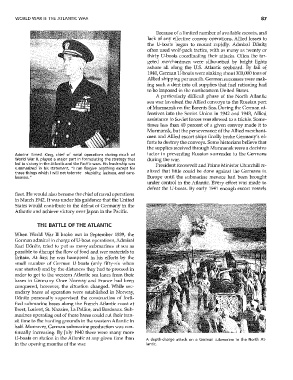
       U-boats on station in the Atlantic at any given time than   A  depth-charge  attack  on  a  German  submarine  in  the  North  At-
       in the opening months of the war.                      lantic.

