


Page 162 - fbkCardioDiabetes_2017
P. 162
138                          Cardio Diabetes Medicine 2017


              gender is observed as risk factor for neurogenic car-  carboxykinase(PEPCK) and  glycogen  phosphory-
              diac enzyme elevation. The pattern of enzyme eleva-  lase  (GPase) thereby  resulting  in hyperglycemia.  In
              tion in coronary artery disease and neurogenic myo-  skeletal  muscles,  down regulation of insulin recep-
              cardial injury are different, helping us to differentiate   tor expression results  in decreased  translocation  of
              between the two.  In case  of  neurogenic  myocardial   glucose transporter  (GLUT4) into  plasma membrane
              damage the rate of enzyme elevation will  be  slow   and hence hyperglycemia, because of impaired glu-
              and the peak values will be low but in coronary artery   cose utilization by the skeletal muscles
              disease  related myocardial injury there will be rapid
              elevation of cardiac  enzymes and the peak  values
              will be high .
                        (1)

              Effects of stroke on diabetes
              The effect of diabetes on the pathogenesis and the
              outcome  of stroke  is  a well known entity. But,  not
              much is known about the effects of stroke on diabe-
              tes and more research is needed to explore this area.
              Diabetes and stroke produces detrimental effects on
              each other, setting a vicious cycle at least during the
              acute  phase  of stroke.  Most evidences (animal  and
              human) available for the effects of stroke on diabe-
              tes are for ischemic strokes.
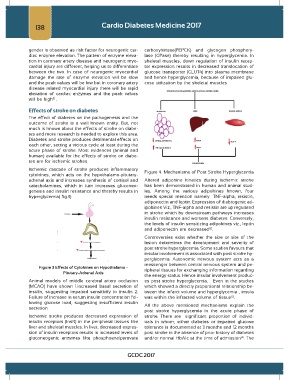
              Ischemic  cascade of stroke produces  inflammatory   Figure 4. Mechanisms of Post Stroke Hyperglycemia
              cytokines, which  acts  on  the  hypothalamo-pitutary-
              adrenal axis and increases synthesis of cortisol and   Altered  adipokine  kinetics  during  ischemic stroke
              catecholamines,  which  in turn increases  gluconeo-  has been demonstrated in human and animal stud-
              genesis and insulin resistance and thereby results in   ies.  Among  the various  adipokines  known, four
              hyperglycemia( fig.3)                              needs  special  mention namely  –TNF-alpha,  resistin,
                                                                 adiponectin and leptin. Expression of diabtogenic ad-
                                                                 ipokines Viz., TNF-alpha and resistin are up regulated
                                                                 in stroke which by downstream pathways increases
                                                                 insulin resistance and worsens diabetes. Conversely,
                                                                 the levels of insulin sensitizing adipokines viz., leptin
                                                                 and adiponectin are decreased .
                                                                                             (2)
                                                                 Controversies  exist  whether the size  or  site  of  the
                                                                 lesion  determines the development and  severity  of
                                                                 post stroke hyperglycemia. Some studies favours that
                                                                 insular involvement is associated with post stroke hy-
                                                 .               perglycemia.  Autonomic  nervous system  acts  as a
                                                                 messenger between central nervous system and pe-
                  Figure 3 Effects of Cytokines on Hypothalamo -    ripheral tissues for exchanging information regarding
                             Pitutary-Adrenal Axis
                                                                 the energy status. Hence insular involvement produc-
              Animal models  of middle cerebral  artery  occlusion   es  post  stroke  hyperglycemia.      Even in the studies
              (MCAO)  have shown 1.increased basal secretion of   which showed a directly proportional relationship be-
              insulin,  suggesting impaired sensitivity to insulin 2.   tween the infarct volume and hyperglycemia , insula
                                                                                                       (2)
              Failure of increase in serum insulin concentration fol-  was within the infracted volume of tissue .
              lowing glucose load, suggesting insufficient  insulin   All  the  above mentioned  mechanisms  explain  the
              secretion.
                                                                 post  stroke  hyperglycemia  in  the acute  phase  of
              Ischemic  stroke produces decreased  expression  of   stroke.  There  are    significant proportion  of  individ-
              insulin receptors (InsR) in the peripheral tissues like   uals in whom, either  diabetes or  impaired  glucose
              liver and skeletal muscles. In liver, decreased expres-  tolerance is documented at 3 months and 12 months
              sion of insulin receptors results in increased levels of   post stroke in the absence of prior history of diabetes
              gluconeogenic enzymes like  phosphoenolpyruvate    and/or normal HbA1c at the time of admission . The
                                                                                                           (4)


                                                         GCDC 2017

