


Page 163 - fbkCardioDiabetes_2017
P. 163
Effect of Stroke on Heart, Diabetes and Hypertension                                   139


                 possible  mechanisms  for  this  are  not yet  very  clear
                 and needs further research.


                 Effect of stroke on hypertension
                 Hypertension  is  one  of  the modifiable  risk  factors
                 for stroke  and  stroke  in turn can  affect  pre-exist-
                 ing  hypertension or  produce  an acute  hypertensive
                 response  due to various factors. Both low and high
                 blood pressure values are detrimental to the outcome
                 of stroke  as shown in the International  stroke  trial,
                 which  suggests  a ‘U’-shaped  relationship  between
                 systolic blood pressure and stroke outcome in terms
                 of both morbidity and mortality. Hence, a detailed un-
                 derstanding of the pathophysiology  of acute  hyper-
                 tensive response is absolutely essential for an appro-
                 priate  management.  Even though  stroke  can  affect
                 blood pressure in either way, the acute hypertensive
                 response is more common than the other, seen ap-
                 proximately  in 50% of stroke  patients according to
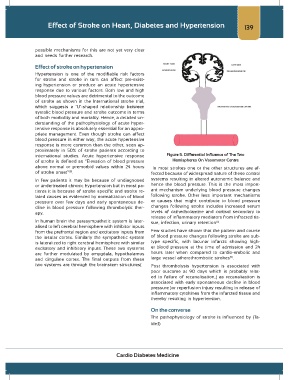
                 international studies.  Acute hypertensive  response      Figure 5. Differential Influence of The Two
                 of stroke is defined as “Elevation of blood pressure        Hemispheres On Vasomotor Centre
                 above normal or  premorbid values within  24 hours     In most strokes one or  the  other  structures are  af-
                                (5)
                 of stroke onset” .                                 fected because of widespread nature of these control
                 In few patients it may be because of undiagnosed   systems resulting in altered autonomic balance and
                 or undertreated chronic hypertension but in most pa-  hence the blood  pressure.  This  is  the most import-
                 tients it is because of stroke specific and stroke re-  ant  mechanism underlying  blood pressure  changes
                 lated causes as evidenced by normalization of blood   following stroke. Other  less important  mechanisms
                 pressure  over  few  days  and early  spontaneous de-  or  causes  that might contribute to blood pressure
                 cline in blood  pressure  following  thrombolytic ther-  changes following  stroke  includes increased  serum
                 apy.                                               levels  of cathecholamine  and  cortisol secondary to
                                                                    release of inflammatory mediators from infracted tis-
                 In human brain the parasympathetic system is later-  sue, infection, urinary retention .
                                                                                                (5)
                 alised to left cerebral hemisphere with inhibitor inputs
                 from the prefrontal region and excitatory inputs from   Few studies have shown that the pattern and course
                 the  insular cortex. Similarly  the  sympathetic  system   of blood pressure changes following stroke are sub-
                 is lateralized to right cerebral hemisphere with similar   type  specific,  with lacunar infarcts showing  high-
                 excitatory and inhibitory inputs. These  two  systems   er  blood pressure at  the  time of admission and  24
                 are  further modulated by  amygdala, hypothalamus   hours later when compared to cardio-embolic and
                                                                                                      (5)
                 and cingulate cortex. The final outputs from these   large vessel atherothrombotic strokes .
                 two systems are through the brainstem structures(  Post thrombolysis  hypertension  is  associated with
                                                                    poor  outcome  at 90 days  which  is  probably  relat-
                                                                    ed to failure of recanalisation,(  as recanaliastion  is
                                                                    associated with early  spontaneous decline  in blood
                                                                    pressure )or reperfusion injury resulting in release of
                                                                    inflammatory cytokines from the infarcted tissue and
                                                                    thereby resulting in hypertension.

                                                                    On the converse
                                                                    The pathophysiology  of stroke  is influenced  by (Ta-
                                                                    ble:1)


                                                    Cardio Diabetes Medicine

