


Page 164 - fbkCardioDiabetes_2017
P. 164
140                          Cardio Diabetes Medicine 2017


                            Heat                           Diabetes                       Hypertension
               High Risk                        1.   Qualitative or quantitative   lschemic
                                                   change in platelets
               1.   Atrial fibrillation                                          1.   Large vessel atherothrombotic
                                                2.  Qualitative or quantitative     disease
               2.  Left atrial or ventricular      increase in procoagulant
                  thrombus and myxoma                                            2.  Small vessel occlusive disease
                                                   activity
               3.  Dilated cardiomyopathy
                                                3.  Quantitative or qualitative   3.  Hypertensive heart disease
               4.  Recent anterior wall MI         decrease in antithrombotic    Hemorrhagic
               5.  Mitral stenosis                 activity
                                                                                 1.   Charcot-bouchard aneurysm
               6.  Endoca rditis                Decreased fibrinolysis
               7.  Prosthetic valve             1. Decreased activity of t-PA    2.  Acute hypertensive crisis
               Low risk                                                          3.  Anurysmal sub-arachnoidl
                                                2. Increased PAI-1 & alpha
                                                                                    haemorrhage
               1.   Congestive cardiac failure
                                                2 antiplasmin
               2.  Dys/akinetic ventricular wall
               3.  Atrilal septal aneurysm
               4.  Mitral-valve prolapsed
               5.  Patent foramen ovale

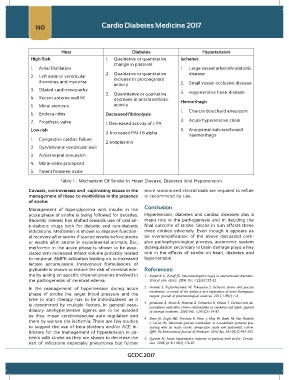
                            Table 1 : Mechanism Of Stroke In Heart Disease, Diabetes And Hypertension

              Caveats, controversies and  captivating issues in the   more randomized clinical trials are required to refute
              management of these co-morbidities in the presence   or recommend its use.
              of stroke:
                                                                 Conclusion
              Management  of hyperglycemia with insulin in the
              acute phase of stroke is being followed for decades.   Hypertension,  diabetes and  cardiac  diseases  play  a
              Recently interest has shifted towards use of oral an-  major  role  in the pathogenesis  and in deciding  the
              ti-diabetic  drugs  both  for diabetic  and  non-diabetic   final outcome of stroke. Stroke in turn affects these
              indications. Metformin is shown to improve function-  three entities adversely.  Even though  it appears  as
              al recovery after stroke if started weeks before stroke   an  oversimplification  of the  above discussed com-
              or weeks after stroke  in experimental  animals. But,   plex  pathophysiological  process,  autonomic  system
              metformin in the acute  phase is shown to be asso-  dysregulation secondary to brain damage plays a key
              ciated with increased infarct volume probably related   role  in the  effects of stroke on heart,  diabetes and
              to neuronal AMPK activation leading on to increased   hypertension.
              lactate  accumulation.  Intravenous formulations of
              glyburide is shown to reduce the risk of cerebral ede-  References:
              ma by acting on specific channel proteins involved in   1.  Kopelnik A, Zaroff JG. Neurocardiogenic injury in neurovascular disorders.
              the pathogenesis of cerebral edema.                  Critical care clinics. 2006 Oct 1;22(4):733-52.

              In the management  of hypertension  during  acute   2.  Harada  S, Fujita-Hamabe W, Tokuyama S. Ischemic stroke and glucose
              phase  of  stroke  the target  blood  pressure  and the   intolerance: a review of the evidence and exploration of novel therapeutic
                                                                   targets. Journal of pharmacological sciences. 2012;118(1):1-3.
              time to start therapy has to be individualised as it
              is  determined  by  multiple  factors. In general  vaso-  3.  Johansson Å, Ahren B, Näsman B, Carlström K, Olsson T. Cortisol axis ab-
                                                                   normalities early after stroke–relationships to cytokines and leptin. Journal
              dilatory antihypertensive  agents are to  be avoided   of internal medicine. 2000 Feb 1;247(2):179-87.
              as  they  impair  cerebrovascular  auto regulation  and   4.  Dave JA, Engel  ME, Freercks  R, Peter  J, May W, Badri M, Van Niekerk
              there by worsen the ischemia. There are few studies   L, Levitt NS. Abnormal glucose metabolism in non-diabetic patients pre-
              to support  the use  of beta-blockers  and/or  ACE in-  senting  with an acute stroke:  prospective study and systematic  review.
              hibitors  for  the management of  hypertension  in pa-  QJM: An International Journal of Medicine. 2010 Apr 28;103(7):495-503.
              tients with stroke as they are shown to decrease the   5.  Qureshi AI. Acute hypertensive response in patients with stroke. Circula-
              risk  of infections especially  pneumonia but further   tion. 2008 Jul 8;118(2):176-87.

                                                         GCDC 2017

