


Page 168 - fbkCardioDiabetes_2017
P. 168
144           Thyroid Dysfunction, Diabetes and the Cardiac Link


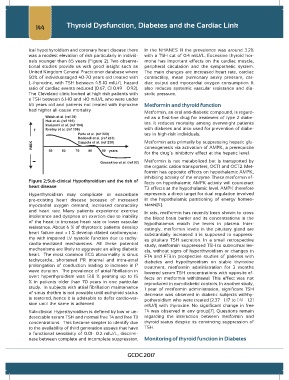
              ical hypothyroidism and coronary heart disease there   In the NHANES  III  the prevalence was around 3.2%
              was a modest elevation of risk particularly in individ-  with a TSH cut of 0.4 mIU/L. Excessive thyroid hor-
              uals younger than 65 years (Figure 2). Two observa-  mone has important  effects on the cardiac  muscle,
              tional studies  provide  us with good  insight such as   peripheral  circulation  and  the sympathetic  system.
              United Kingdom General Practitioner database where   The main changes  are  increased  heart rate, cardiac
              50% of individualsaged 40-70 years old treated with   contractility,  mean pulmonary  artery  pressure,  car-
              L-thyroxine,  with TSH  between 4.5-10 mIU/L  hazard   diac output and myocardial oxygen  consumption.  It
              ratio of cardiac events reduced (0.67, CI 0.49 – 0.92).  also reduces systemic vascular  resistance and  dia-
              The Cleveland clinic looked at high risk patients with   stolic pressure.
              a TSH between 6.1-10 and >10 mIU/L who were under
              65 years old and patients not treated with thyroxine  Metformin and thyroid function
              had higher all-cause mortality.
                                                                 Metformin, an oral anti-diabetic compound, is regard-
                     Walsh et al. (ref 38)                       ed as a first-line drug for treatment of type 2 diabe-
                     Hak et al. (ref 193)                        tes. It reduces mortality among  overweight patients
                     Imaizumi et al. (ref 194)
                     Kvetny et al. (ref 196)                     with diabetes and also used for prevention of diabe-
                                   Parle et al. (ref 229)        tes in high-risk individuals.
                                   Rodondi et al. (ref 231)      Metformin acts primarily by suppressing hepatic glu-
               RISK                Cappola et al. (ref 230)      coneogenesis via activation of AMPK, a prerequisite
                      50    60    70    80    90 years
                                                                 for the drug’s inhibitory effect at the hepatic level.
                                                                 Metformin  is  not metabolized but is  transported  by
                                             Gussekloo et al. (ref 92)
                                                                 the organic cation transporters, OCT1 and OCT2. Met-
                                                                 formin has opposite effects on hypothalamic AMPK,
                                                                 inhibiting activity of the enzyme. These metformin ef-
              Figure 2;Sub-clinical Hypothyroidism and the risk of   fects on hypothalamic AMPK activity will counteract
              heart disease                                      T3 effects at the hypothalamic level. AMPK therefore

              Hyperthyroidism  may  complicate or  exacerbate    represents a direct target for dual regulation involved
              pre-existing  heart disease  because of increased   in the hypothalamic  partitioning of energy  homeo-
              myocardial oxygen  demand,  increased contractility   stasis[4].
              and heart rate.  Many  patients  experience  exercise   In rats, metformin has recently been shown to cross
              intolerance and dyspnea on exertion due to inability   the blood–brain barrier and its concentrations  in the
              of the heart to increase heart rate or lower vascular   hypothalamus  match  the  levels  in plasma. Inter-
              resistance. About 6 % of thyrotoxic patients develop   estingly,  metformin levels  in the pituitary gland are
              heart failure and < 1 % develop dilated cardiomyopa-  substantially increased  it is  supposed  to suppress-
              thy with impaired LV systolic function due to tachy-  es  pituitary TSH  secretion. In a small retrospective
              cardia-mediated  mechanisms.  All  these potential   study, metformin suppressed TSH to subnormal lev-
              mechanisms are likely to aggravate an ailing diabetic   els,  without signs  of  hyperthyroidism  or  changes in
              heart.  The most common ECG abnormality is sinus   FT4 and  FT3.In prospective  studies of patients with
              tachycardia,  shortened PR interval and  intra-atrial   diabetes  and hypothyroidism on stable  thyroxine
              prolongation of conduction  leading to increase in P   treatment,  metformin administration for  3 months
              wave duration.  The prevalence of atrial fibrillation in   lowered serum TSH concentrations with opposite ef-
              overt  hyperthyroidism  was 13.8 % peaking  up  to 15   fects on metformin withdrawal.  This  effect was not
              % in patients older  than  70 years  in one particular   reproduced in non-diabetic controls. In another study,
              study.  In subjects with atrial fibrillation maintenance   1 year of metformin  administration,  significant  TSH
              of sinus rhythm is not possible until euthyroid status   decrease  was observed  in diabetic subjects withhy-
              is restored, hence it is advisable to defer cardio-ver-  pothyroidism who were treated (2.37 ± 1.17 to 1.41 ± 1.21
              sion until the same is achieved.                   mIU/l) with  thyroxine.  No significant  change  in free
              Sub-clinical Hyperthyroidism is defined by low or un-  T4 was observed in any group[7]. Questions remain
              detectable serum TSH and normal free T4 and free T3   regarding  the interaction  between metformin  and
              concentrations.  This became simpler to identify due   thyroid status  despite  its convincing  suppression of
              to the availability of third generation assays that have   TSH.
              a functional sensitivity of 0.01- 0.2 mIU/L,  discrimi-
              nate between complete and incomplete suppression.  Monitoring of thyroid function in Diabetes


                                                         GCDC 2017

