


Page 172 - fbkCardioDiabetes_2017
P. 172
148                          Cardio Diabetes Medicine 2017


              tionary  mechanism  is  linked  to the sodium-glucose
              transporter  2 (SLGT2)  in the proximal  tubule.  SLGT2
              is a low-affinity and high-capacity transporter and is
              responsible for >90% of glucose reabsorption in the
              proximal  tubule.  Animals with  a genetic deficiency
              of SLGT2 lose approximately 60%  of their filtered
              glucose into the urine. In settings of hyperglycemia,
              there  is  upregulation of  SLGT2  expression  which  is
              believed to be of evolutionary benefit as it allows for
              glucose reabsorption and hence energy conservation
              for both the body and brain.

              Clinical manifestations and natural history
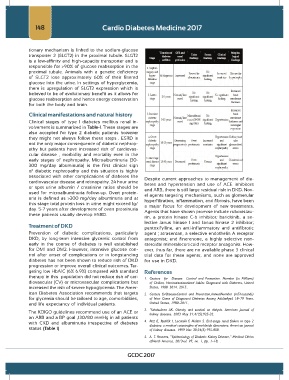
              Clinical stages  of  type  1 diabetes  mellitus renal  in-
              volvement is summarized in Table-1. These stages are
              also  accepted  for  type  2  diabetic patients  however
              they might not always  follow  these steps  . ESRD is
              not the only major consequence of diabetic nephrop-
              athy but patients have increased  risk  of cardiovas-
              cular  disease  , morbidity and  mortality even in the
              early  stages  of nephropathy. Microalbuminuria (30-
              300  mg/day  albuminuria)  is  the first  clinical sign
              of diabetic  nephropathy and  this situation  is highly
              associated with other complications of diabetes like   Despite  current  approaches to management  of dia-
              cardiovascular disease and retinopathy. 24 hour urine   betes and hypertension and use of ACE inhibitors
              or  spot  urine  albumin /  creatinine ratios  should be   and ARB, there is still large residual risk in DKD. Nov-
              used  for  microalbuminuria follow-up.  Overt protein-  el agents targeting mechanisms, such as glomerular
              uria is  defined as >300  mg/day  albuminuria  and at   hyperfiltration, inflammation, and fibrosis, have been
              this stage total protein loss in urine might exceed 1g/  a major  focus for  development of new treatments.
              day. 5-7 years after development of overt proteinuria   Agents that have shown promise include ruboxistau-
              these patients usually develop ESRD.
                                                                 rin, a protein  kinase  C-b inhibitor; baricitinib, a se-
                                                                 lective Janus  kinase  1 and Janus kinase  2 inhibitor;
              Treatment of DKD                                   pentoxifylline,  an anti-inflammatory  and antifibrotic
              Prevention of diabetic complications,  particularly   agent ; atrasentan, a selective endothelin A receptor
              DKD,  by long-term  intensive glycemic control from   antagonist;  and finerenone, a highly  selective  non-
              early  in the  course of diabetes is well established   steroidal mineralocorticoid receptor antagonist. How-
              for  DM1 and DM2. However,  intensive glucose  con-  ever, thus far, there are no available phase 3 clinical
              trol after onset of complications  or  in longstanding   trial data  for these agents, and  none  are  approved
              diabetes has not been shown to reduce risk of DKD   for use in DKD.
              progression or improve overall clinical outcomes. Tar-
              geting low HbA1C (6%–6.9%) compared with standard   References
              therapy in this  population did not reduce risk of car-  1.  Centers  for  Disease  Control and Prevention.  Number (in Millions)
              diovascular (CV) or  microvascular complications but   of Civilian,  Noninstitutionalized  Adults  Diagnosed  with  Diabetes,  United
              increased the risk of severe hypoglycemia. The Amer-  States, 1980–2014. 2015..
              ican Diabetes Association recommends that targets   2.  Centers  forDiseaseControl  and Prevention,AnnualNumber  (inThousands)
              for glycemia should be tailored to age, comorbidities,   of New Cases of Diagnosed Diabetes  Among AdultsAged 18–79  Years,
              and life expectancy of individual patients.          United States, 1980–2011,
              The KDIGO guidelines recommend use of an ACE or    3.  “Salahudeen  AK. Obesity  and survival  on dialysis.  American journal of
                                                                   kidney diseases. 2003 May 31;41(5):925-32.
              an ARB and a BP goal ,130/80 mmHg in all patients
              with  CKD and albuminuria  irrespective  of diabetes   4.  Ritz  E, Rychlík  I, Locatelli  F, Halimi  S. End-stage  renal  failure  in  type  2
                                                                   diabetes: a medical catastrophe of worldwide dimensions. American journal
              status (Table 1)                                     of kidney diseases. 1999 Nov 30;34(5):795-808.
                                                                 5.  A. T. Reutens, “Epidemiology of Diabetic Kidney Disease,” Medical Clinics
                                                                   ofNorth America, 2013vol. 97, no. 1, pp. 1–18, .


                                                         GCDC 2017

