


Page 248 - fbkCardioDiabetes_2017
P. 248
224                      Cardio Diabetes Medicine 2017


                                                                 Etiology:
                                                                 •   AV node disease

                                                                 •   Enhanced vagal tone
                                                                 •   Acute inferior wall MI
                                                                 •   Electrolyte disturbances
                                                                 Drugs: ß blockers, Calcium channel blockers, cardiac
                                                                 glycosides
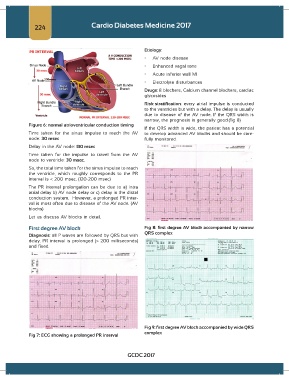
                                                                 Risk stratification:  every  atrial  impulse  is  conducted
                                                                 to the ventricles but with a delay. The delay is usually
                                                                 due to disease  of the AV node. If the QRS width  is
                                                                 narrow, the prognosis is generally good.(fig 8)
              Figure 6: normal atrioventricular conduction timing
                                                                 If the QRS width is wide, the patient has a potential
              Time taken for the sinus impulse  to reach the  AV   to develop advanced AV blocks and should be care-
              node: 30 msec                                      fully monitored.

              Delay in the AV node: 130 msec
              Time  taken for  the impulse  to travel  from  the AV
              node to ventricle: 30 msec.

              So, the total time taken for the sinus impulse to reach
              the ventricle, which  roughly  corresponds  to the PR
              interval is < 200 msec. (120-200 msec)

              The PR interval prolongation can  be due to a)  intra
              atrial delay b) AV node delay or c) delay in the distal
              conduction system.  However, a prolonged PR inter-
              val is most often due to disease of the AV node. (AV
              blocks)
              Let us discuss AV blocks in detail.

              First degree AV block                              Fig 8: first  degree  AV block accompanied  by  narrow
              Diagnosis: all P waves are followed by QRS but with   QRS complex
              delay.  PR interval is  prolonged  (> 200  milliseconds)
              and fixed.


                                                                 Fig 9: first degree AV block accompanied by wide QRS
                                                                 complex
              Fig 7: ECG showing a prolonged PR interval


                                                         GCDC 2017

