


Page 399 - fbkCardioDiabetes_2017
P. 399
Cardio Diabetes Medicine 2017                                   375


                                                                    Conclusion :
                                                                      Hybrid  PET/MR imaging could also  become the
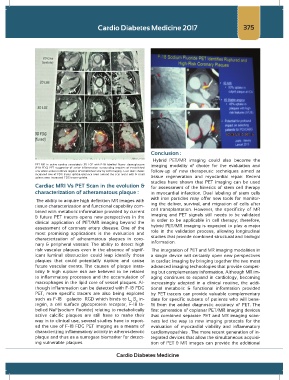
                 PET  MR in active cardiac sarcoidosis  3D LGE with F-18 labelled  fluoro-  deoxyglucose   imaging  modality  of  choice for  the evaluation  and
                 (F-18  FDG)  PET suggestive  of active  inflammation  surrounding requires  of established
                 scar white arrows indicate regions of established scar by LGE imaging . Last rows shows   follow-up of new therapeutic  techniques  aimed at
                 increased row of FDG tracer uptake entrance rows around the scar areas with & small
                 spleen rows increased FDG tracer uptake.           tissue regeneration and myocardial repair.  Recent
                                                                    studies  have shown that  PET  imaging  can be  used
                 Cardiac MRI Vs PET Scan in the evolution &         for  assessment  of the kinetics of stem cell therapy
                 characterization of atheramatous plaque :          in myocardial infarction.  Dual labeling of stem cells
                  The ability to acquire high definition MR images with   with  iron particles  may offer  new tools for  monitor-
                 tissue characterization and functional capability com-  ing  the deliver,  survival, and migration  of  cells  after
                 bined with metabolic information provided by current   cell transplantation.  However, the  specificity of MR
                 &  future PET  tracers  opens  new  perspectives  in  the   imaging  and PET  signals  still  needs  to be  validated
                 clinical application of PET/MR  imaging  beyond  the   in order  to be  applicable  in cell  therapy;  therefore,
                 assessment  of  coronary  artery  disease.  One of  the   hybrid PET/MR imaging is expected to play a major
                 most promising  applications  is  the evaluation  and   role  in the validation process,  allowing  longitudinal
                 characterization  of  atheramatous plaques  in coro-  studies that provide combined structural and biologic
                 nary  &  peripheral  vassals.  The  ability  to detect high   information.
                 risk vascular plaques even in the absence of signif-   The integration of PET and MR imaging modalities in
                 icant  luminal obstruction could leap  identify  those   a single device  will  certainly open  new perspectives
                 plaques  that  could potentially  rupture  and cause   in cardiac imaging by bringing together the two most
                 future vascular events.  The  causes of  plaque  insta-  advanced imaging technologies that provide compet-
                 bility  &  high rupture  risk  are  believed  to be  related   ing but complementary information. Although MR im-
                 to inflammatory processes and the accumulation of   aging  continues to expand in cardiology,  becoming
                 macrophages in the lipid core of vessel plaques. Al-  increasingly  adopted  in  a  clinical routine, the addi-
                 though inflammation can be detected with F-18 FDG   tional  metabolic & functional information  provided
                 PET, more  specific  tracers  are  also  being  explored   by PET tracers can provide valuable complementary
                 such as F-18 – galacto –RGD which binds to L B  in-  data  for  specific  subsets  of patients who will  bene-
                                                           v
                                                             3
                 tegrin,  a cell  surface glycoprotein  receptor,  F-18 la-  fit from the  added diagnostic accuracy  of PET. The
                 belled NaF(sodium fluoride) relating to metabolically   first generation of coplanar PET/MR imaging devices
                 active calcific  plaques  are  still  have to make  their   that  combined  separate  PET and  MR imaging scan-
                 way in to clinical use, several studies have to report-  ners  led the  way to new imaging protocols  for the
                 ed the use of F-18 FDG PET imaging as a means of   evaluation  of myocardial viability and  inflammatory
                 characterizing inflammatory activity in atherosclerotic   cardiomyopathies . The more recent generation of in-
                 plaque and thus as a surrogate biomarker for detect-  tegrated devices that allow the simultaneous acquisi-
                 ing vulnerable plaques.                            tion of PET & MR images can provide the additional


                                                    Cardio Diabetes Medicine

