


Page 396 - fbkCardioDiabetes_2017
P. 396
372                                Cardiac  MRI  vs  PET Scan


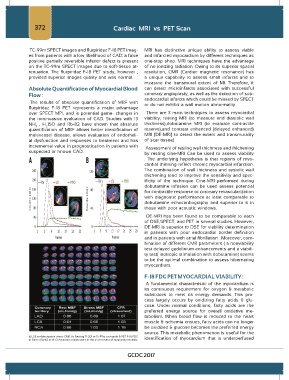
               TC-99m SPECT images and flurpiridaz F-18 PET imag-  MRI has distinctive unique ability  to assess  viable
              es from patients with a low likelihood of CAD: a false   and infarcted myocardium by different techniques as
              positive  partially  reversible  inferior  defect is  present   one-stop  shop.  MRI techniques have the advantage
              on the TC-99m SPECT images due to soft-tissue at-  of no ionizing radiation. Owing to its superior spatial
              tenuation.  The flurpiridaz  F-18 PET study, however ,   resolution, CMR (Cardiac  magnetic  resonance)  has
              provided superior images quality and was normal.   a unique capability  to assess  small  infarcts and to
                                                                 measure the  transmural  extent  of MI. Therefore,  it
              Absolute Quantification of Myocardial Blood        can  detect microinfarcts associated with successful
              Flow :                                             coronary angioplasty, as well as the detection of sub-
                                                                 endocardial infarcts which could be missed by SPECT
               The  results of  absolute  quantification  of  MBF  with   or do not exhibit a wall motion abnormality.
              flurpiridaz  F-18 PET represents  a major advantage
              over SPECT MPI, and  is  potential game- changer in    There  are  3 main  techniques to assess  myocardial
              the noninvasive evaluation  of  CAD. Studies  with 13   viability; resting  MRI (to  measure  end diastolic wall
              NH  , H 15O and Rb-82 have shown that  absolute    thickness),dobutamine  MRI (to evaluate contractile
                 3
                     2
              quantification  of  MBF  allows  better  identification  of   reserve),and contrast  enhanced  (delayed enhanced)
              multivessel  disease,  allows  evaluation of  endotheli-  MRI [DE-MRI] to detect the extent and transmurality
              al  dysfunction and responses  to treatment and has   of scar tissue)
              incremental value in prognostication in patients with    Assessment of resting wall thickness and thickening
              suspected or known CAD.
                                                                 by resting  cine-MRI  Can  be used to  assess  viability
                                                                 . The underlying hypothesis is that  regions  of myo-
                                                                 cardial thinning reflect chronic myocardial infarction.
                                                                 The combination  of wall thickness and systolic  wall
                                                                 thickening tend to improve the sensitivity and spec-
                                                                 ificity of the technique.  Cine-MRI performed  during
                                                                 dobutamine  infusion can  be used assess  potential
                                                                 for contractile response to coronary revascularization
                                                                 with  diagnostic performance at least comparable to
                                                                 dobutamine  echocardiography and superior  to it in
                                                                 those with poor acoustic windows.

                                                                  DE-MRI has been found  to be comparable to each
                                                                 of DSE,SPECT, and PET in several studies. However,
                                                                 DE-MRI is superior to DSE for viability determination
                                                                 in patients with  poor  endocardial border  definition
                                                                 and in patients with atrial fibrillation . Moreover, com-
                                                                 bination of different CMR parameters ( a nonviability
                                                                 test delayed gadolinium enhancements and a viabili-
                                                                 ty test( inotropic stimulation with dobutamine) seems
                                                                 to be the optimal combination to assess hibernating
                                                                 myocardium.

                                                                 F-18 FDG PET MYOCARDIAL VIABILITY :
                                                                  A  fundamental  characteristic of  the myocardium is
                                                                 its continuous requirement  for  oxygen  &  metabolic
                                                                 substrates  to meet  its  energy  demands. This  pro-
                                                                 cess  largely  occurs by  oxidizing  fatty acids &  glu-
                                                                 cose. Under  normal conditions, fatty acids are  the
                                                                 preferred  energy  source  for  overall  oxidative me-
                                                                 tabolism. When blood flow is  reduced to the heart
                                                                 muscle & ischemia ensues, fatty acids can no longer
                                                                 be oxidized & glucose becomes the preferred energy
                                                                 source. This metabolic phenomenon is useful for the
              ii) LGE or dobutamine stress CMR Vs Resting Tl-201 or Tc 99m sestamibi & PET F-18 FDG   identification  of myocardium that  is  underperfused
              or Stress Rb-82 or N-13 Ammonia radiotracers in the assessment of myocardial viability.


                                                         GCDC 2017

