


Page 395 - fbkCardioDiabetes_2017
P. 395
Cardio Diabetes Medicine 2017                                    371


                 negative  charge, 18FDG-6- phosphate  is  trapped  in-
                 tracellularly.

                 The feasibility  and accuracy  of exercise  18FDG  im-
                 aging  for  hot spot  imaging  of exercise  induced
                 myocardial ischemia was studied by  performing  si-
                 multaneous  exercise  perfusion  and 18FDG imaging
                 in patient scheduled to undergo  exercise  and rest
                 myocardial perfusion  imaging  for  suspected  CAD.
                 All  patients underwent a symptom  –limited  exercise
                 after an overnight fast. 99mTc-sestamibi (25mci) and
                 18FDG  (8-10mCi)  were  injected iv at  peak  exercise.
                 The patients underwent  imaging using a dual-head   Weishaowu
                 large field of view single –crystal SPECT imaging cam-
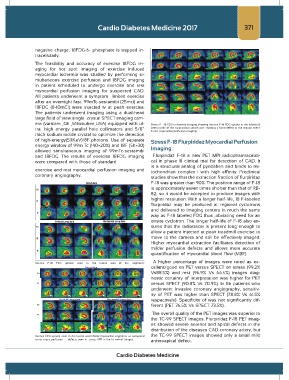
                 era (varicam ,GE ,Milwaukee,USA) equipped with ul-  Stress F  -18 FDG ischaemia imaging showing intense F-18 FDG uptake in the inferior &
                 tra  –high energy  parallel  hole  collimators  and 5/8”   lateral walls of the myocardium which was showing a fixed defect in the regular stress
                                                                    & rest myocardial perfusion imaging.
                 thick sodium iodide crystal to optimize the detection
                 of high-energy(511KeV)18F photons. Use of separate   Stress F-18 Flurpiridaz Myocardial Perfusion
                 energy window of 99m Tc (140+20%) and 18F (511+30)
                 allowed  simultaneous imaging  of 99mTc-sestamibi   Imaging :
                 and 18FDG.  The  results  of exercise  18FDG  imaging    Flurpiridaz  F-18  a new  PET MPI radiopharmaceuti-
                 were compared with those of standard               cal in phase  III  clinical trial  for  detection of CAD. It
                                                                    is a structural analog of pyridaben and binds to mi-
                 exercise and rest myocardial perfusion imaging and   tochondrian  complex  I  with high affinity. Preclinical
                 coronary angiography.                              studies show that the extraction fraction of flurpiridaz
                                                                    F-18 was greater than 90%. The positron range of F-18
                                                                    is approximately seven times shorter than that of RB-
                                                                    82, so it would be accepted to produce images with
                                                                    higher resolution. With a longer half-life, 18 F-labeled
                                                                    flurpiridaz  may be produced at  regional  cyclotrons
                                                                    and delivered to imaging centers in much the same
                                                                    way as F-18 labeled FDG thus ,obviating need for an
                                                                    onsite cyclotron. The longer half-life of F-18 also en-
                                                                    sures that the radiotracer is present long enough to
                                                                    allow a patient injected at peak treadmill exercise to
                                                                    move to the camera and still  be  effectively  imaged.
                                                                    Higher  myocardial  extraction  facilitates detection of
                                                                    milder  perfusion defects and  allows  more  accurate
                                                                    quantification of myocardial blood flow (MBF).
                                                                      A  higher  percentage of  images  were  rated  as  ex-
                 Intense  F-18  FDG  uptake  seen  in  the  lateral  wall  of  the  segments
                                                                    cellent/good on PET versus SPECT on stress (99.2%
                                       Short Axis
                                                                    Vs88.5%)  and  rest  (96.9%  Vs 66.4%)  images  diag-
                 Ex
                                                                    nostic  certainty of interpretation was higher for PET
                 R                                                  versus SPECT (90.8% Vs 70.9%). In 86 patients who
                                                                    underwent invasive coronary angiography,  sensitiv-
                                                                    ity of PET was higher  than  SPECT (78.8%  Vs 61.5%
                           Vertical Long Axis   Horizontal Long Axis  respectively).  Specificity  of was not significantly dif-
                 Ex                                                 ferent (PET 76.5% Vs SPECT 73.5%).
                                                                     The overall quality of the PET images was superior to
                 R
                                                                    the TC-99 SPECT images. Flurpiridaz F-18 PET imag-
                                                                    es showed severe anterior and apical defects in the
                                                                    distribution of the diseases CAD coronary artery, but
                   gx                                   Jain et al
                 intense FDG uptake seen in the lateral and inferior myocardial segments as compared   the TC-99 SPECT images  showed only a small mild
                 to no stress perfusion    defects seen in  stress MPI in the Ist row of images.  anteroapical defect.


                                                    Cardio Diabetes Medicine

