


Page 394 - fbkCardioDiabetes_2017
P. 394
370                                Cardiac  MRI  vs  PET Scan


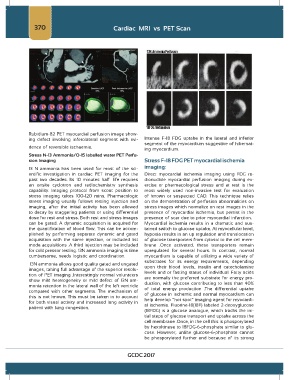
              Rubidium-82 PET myocardial perfusion image show-
              ing defect  involving  inferolateral  segment with  evi-  Intense F-18 FDG uptake in the lateral and  inferior
              dence of reversible ischaemia.                     segment of the myocardium suggestive of hibernat-
                                                                 ing myocardium.
              Stress N-13 Ammonia/O-15 labelled water PET Perfu-
              sion Imaging                                       Stress F-18 FDG PET myocardial ischemia

              13  N ammonia has been used for most of the  sci-  imaging:
              entific investigation in cardiac PET  imaging  for  the   Direct  myocardial ischemia  imaging using FDG  ra-
              past two  decades. Its 10  minutes  half  –life requires   dionuclide myocardial perfusion imaging during ex-
              an onsite  cyclotron and radiochemistry  synthesis   ercise  or  pharmacological stress  and  at  rest  is  the
              capability. Imaging  protocol from scout  position to   most widely  used  non-invasive test for  evaluation
              stress  imaging takes 100-120  mins. Pharmacologic   of known  or  suspected CAD. This technique  relies
              stress  imaging usually follows resting  injection  and   on the demonstration of perfusion abnormalities on
              imaging,  after  the initial activity has been  allowed   stress images which normalize on rest images in the
              to decay by staggering patients or using differential   presence  of myocardial ischemia,  but  persist  in the
              dose for rest and stress. Both rest and stress images   presence of scar due to prior myocardial infarction.
              can  be gated. A dynamic  acquisition is acquired for   Myocardial ischemia results in a dramatic  and  sus-
              the quantification of blood flow. This can be accom-  tained switch to glucose uptake. At myocellular level,
              plished  by performing  separate  dynamic  and  gated   hypoxia results in an up regulation and translocation
              acquisition  with the  same injection,  or included  list   of glucose transporters from cytosol to the cell mem-
              mode acquisitions .A third injection may be included   brane .Once  activated,  these transporters  remain
              for cold pressor testing. 13N ammonia imaging is time   upregulated  for  several  hours. In contrast,  normal
              cumbersome, needs logistic and coordination.       myocardium  is capable of utilizing a wide variety of
                                                                 substrates  for its  energy  requirements,  depending
               13N ammonia allows good quality gated and ungated   upon their  blood  levels,  insulin and catecholamine
              images, taking full advantage of the superior resolu-  levels and or fasting status of individual. Fatty acids
              tion of PET imaging .Interestingly  normal volunteers   are normally the preferred substrate for energy pro-
              show mild  heterogeneity  or  mild  defect of  13N  am-  duction,  with  glucose contributing to less  than  40%
              monia retention in the lateral wall of the left ventricle   of total energy  production  .The differential uptake
              compared with other segments.  The  mechanism  of   of glucose in ischemic and normal myocardium can
              this is not known. This must be taken in to account   help develop “hot spot” imaging agent for myocardi-
              for both visual activity and increased lung activity in   al ischemia. Fluorine-18(18F) labeled 2-deoxyglucose
              patient with lung congestion.
                                                                 (18FDG) is a glucose analogue, which tracks the ini-
                                                                 tial steps of glucose transport and uptake across the
                                                                 cell membrane .Once, in the cell this is phosporylated
                                                                 by hexokinase to 18FDG-6-phosphate similar to glu-
                                                                 cose.  However,  unlike  glucose-6-phosphate  cannot
                                                                 be phosporylated  further and because of its strong


                                                         GCDC 2017

