


Page 423 - fbkCardioDiabetes_2017
P. 423
Percutaneous Heart Repair -                                 399
                                           Can We Replace Open Heart Surgery


                 curred during the first 6 months. Between 6 months   recently.
                 and  5 years,  however, there was no difference  be-
                 tween the percutaneous and surgical  groups  in the
                 incidence of  surgery  for  mitral dysfunction.  Surgery
                 was more effective than  MitraClip in terms of free-
                 dom from MR and repeat mitral surgery. MitraClip is
                 not a replacement for surgery, but rather is a viable
                 option for selected patients who are thought to be at
                 prohibitive surgical risk.
                 A propensity-matched  comparison  of EVEREST II
                 HRR/REALISM  patients and high-risk  Duke Echo-
                 cardiography  Laboratory  Database  patients man-
                 aged nonsurgically suggested a survival benefit with
                 MitraClip  therapy at  12 months (relative risk,  0.64;
                 P  =  .013).  Similarly,  a propensity-matched  cohort of
                 120 patients with cardiomyopathy and functional MR
                 showed improved rates of hospital readmission and
                 overall  survival  when MitraClip  therapy  was com-
                 pared to optimal medical therapy.
                 Mitral  Valve  Replacement experience  remains  at an
                 early  stage.  There  have been important challenges
                 in the  development  of  this technology, including
                 the  complexity of the  mitral valve anatomy  involv-
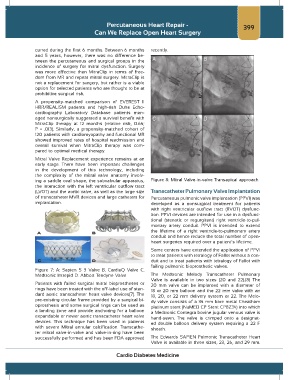
                 ing  a saddle  oval shape,  the subvalvular apparatus,   Figure 8: Mitral Valve-in-valve Transapical approach.
                 the interaction with the left ventricular outflow tract
                 (LVOT) and the aortic valve, as well as the large size  Transcatheter Pulmonary Valve Implantation
                 of transcatheter MVR devices and large catheters for   Percutaneous pulmonic valve implantation (PPVI) was
                 implantation.                                      developed  as  a nonsurgical treatment  for  patients
                                                                    with  right ventricular  outflow  tract  (RVOT)  dysfunc-
                                                                    tion. PPVI devices are intended for use in a dysfunc-
                                                                    tional (stenotic or  regurgitant)  right  ventricle-to-pul-
                                                                    monary artery conduit.  PPVI  is  intended to extend
                                                                    the lifetime of  a right  ventricle-to-pulmonary  artery
                                                                    conduit and hence reduce the total number of open-
                                                                    heart surgeries required over a patient’s lifetime.
                                                                    Some centers have extended the application of PPVI
                                                                    to treat patients with tetralogy of Fallot without a con-
                                                                    duit and to treat patients with tetralogy of Fallot with
                                                                    failing pulmonic bioprosthetic valves.
                 Figure  7: A:  Sapien  S  3 Valve  B.  CardiaQ Valve C.
                 Medtronic Intrepid D. Abbott Tendyne Valve         The  Medtronic Melody  Transcatheter Pulmonary
                                                                    Valve is  available  in two sizes  (20  and 22).(8)  The
                 Patients with failed  surgical  mitral  bioprostheses  or   20  mm  valve can  be implanted with  a diameter of
                 rings have been treated with the off-label use of stan-  18 or  20 mm balloon and the 22 mm valve with an
                 dard aortic transcatheter  heart valve devices(7).  The   18, 20, or  22 mm delivery  system  or  22. The  Melo-
                 pre-existing circular frame provided by a surgical bi-  dy valve consists of a 34 mm bare metal Cheatham
                 oprosthesis and some surgical rings can be used as   platinum stent (NuMED CP Stent CP8Z34) into which
                 a landing zone  and  provide  anchoring  for a balloon   a Medtronic Contegra bovine jugular venous valve is
                 expandable or newer aortic transcatheter heart valve   hand-sewn. The  valve is  crimped  onto a  designat-
                 devices.  This  technique has  been  used  in  patients   ed double balloon delivery  system  requiring  a 22 F
                 with severe  Mitral  annular calcification.  Transcathe-  sheath.
                 ter  mitral valve-in-valve and valve-in-ring  have been
                 successfully performed and has been FDA approved   The  Edwards  SAPIEN  Pulmonic Transcatheter Heart
                                                                    Valve is available in three sizes, 23, 26, and 29 mm.


                                                    Cardio Diabetes Medicine

