


Page 420 - fbkCardioDiabetes_2017
P. 420
396                      Cardio Diabetes Medicine 2017


                   Percutaneous Heart Repair- Can We Replace

                                           Open Heart Surgery


                                       Dr.Puvi Seshiah, MD, FACC, FSCAI, FRCP (G)
                                               Director, structural Heart Program,

                                               TriHealth Heart Institute, Cincinnati


              Coronary  angioplasty  was  the first  percutaneous
              therapy that revolutionized minimally invasive thera-
              pies for heart disease. 2017 is the 40  year anniversa-
                                              th
              ry of the first PTCA performed in man. In 1984 the first
              mitral balloon valvuloplasty was  described  by  Inoue
              followed  by aortic valvuloplasty by Dr. Alain Cribier.
              This soon led to the first aortic valve implant in a pig
              by Dr. Hening Andersen in 1989. First human implant
              of catheter based valve was done in 2000 – RV to PA
              conduit by Dr. Bonhoeffer.Percutaneous valve thera-
              pies have evolved since the first transcatheter aortic
              valve implant in 2002. The therapy has changed how
              we approach and treat valve disease.  Advances in
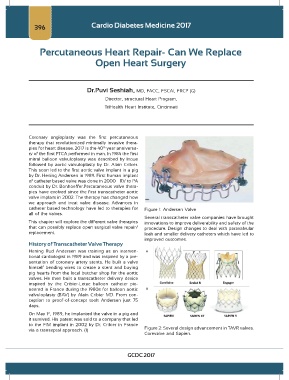
              catheter based technology have led to therapies for   Figure 1: Andersen Valve
              all of the valves.
                                                                 Several transcatheter valve companies have brought
              This chapter will explore the different valve therapies   innovations to improve deliverability and safety of the
              that can possibly replace open surgical valve repair/   procedure. Design changes to deal with paravalvular
              replacement.                                       leak and smaller delivery catheters which have led to
                                                                 improved outcomes.
              History of Transcatheter Valve Therapy
              Hening  Rud Andersen  was training  as  an interven-
              tional cardiologist in 1989 and was inspired by a pre-
              sentation  of coronary artery stents.  He  built  a valve
              himself bending wires  to create a stent  and  buying
              pig hearts from the local butcher shop for the aortic
              valves. He  then built a transcatheter  delivery  device
              inspired  by  the  Cribier-Letac  balloon  catheter pio-
              neered in France during the 1980s for balloon aortic
              valvuloplasty (BAV) by  Alain  Cribier  MD. From  con-
              ception to proof-of-concept  took  Andersen  just  75
              days.

              On May 1 , 1989, he implanted the valve in a pig and
                      st
              it survived. His patent was sold to a company that led
              to the FIM  implant in 2002  by  Dr. Cribier  in France
              via a transeptal approach. (1)                     Figure 2: Several design advancement in TAVR valves.
                                                                 Corevalve and Sapien.


                                                         GCDC 2017

