


Page 122 - Physics Form 5 KSSM_Neat
P. 122
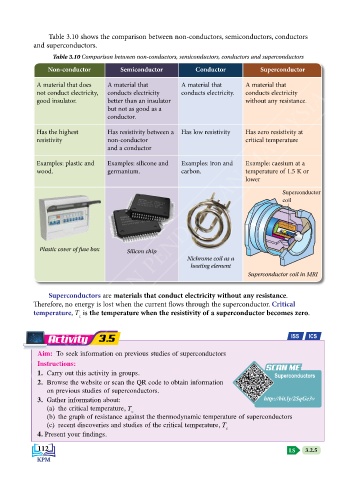
Table 3.10 shows the comparison between non-conductors, semiconductors, conductors
           and superconductors.
                 Table 3.10 Comparison between non-conductors, semiconductors, conductors and superconductors
               Non-conductor         Semiconductor          Conductor          Superconductor

            A material that does   A material that     A material that     A material that
            KEMENTERIAN PENDIDIKAN MALAYSIA
            not conduct electricity,   conducts electricity    conducts electricity.  conducts electricity
            good insulator.      better than an insulator                  without any resistance.
                                 but not as good as a
                                 conductor.

            Has the highest      Has resistivity between a  Has low resistivity  Has zero resistivity at
            resistivity          non-conductor                             critical temperature
                                 and a conductor

            Examples: plastic and   Examples: silicone and   Examples: iron and   Example: caesium at a
            wood.                germanium.            carbon.             temperature of 1.5 K or
                                                                           lower

                                                                                      Superconductor
                                                                                      coil


             Plastic cover of fuse box   Silicon chip
                                                         Nichrome coil as a
                                                          heating element
                                                                           Superconductor coil in MRI


                Superconductors are materials that conduct electricity without any resistance.
           Therefore, no energy is lost when the current flows through the superconductor. Critical
           temperature, T  is the temperature when the resistivity of a superconductor becomes zero.
                         c

                Activity       3.5                                                      ISS   ICS


            Aim:  To seek information on previous studies of superconductors
            Instructions:                                                        SCAN ME
                                                                                 SCAN ME
            1.  Carry out this activity in groups.                                 Superconductors
            2.  Browse the website or scan the QR code to obtain information
               on previous studies of superconductors.
            3.  Gather information about:                                       http://bit.ly/2SqGe3v
               (a)  the critical temperature, T
                                        c
               (b)  the graph of resistance against the thermodynamic temperature of superconductors
               (c)  recent discoveries and studies of the critical temperature, T
                                                                     c
            4. Present your findings.
            112                                                                         LS     3.2.5

