


Page 117 - Physics Form 5 KSSM_Neat
P. 117
Results:                                                                                   CHAPTER 3
                                                    Table 3.6

                 Length of wire, l / cm  Current , I / A  Potential difference, V / V  Resistance, R / Ω  Electricity
                         20.0
                         40.0
              KEMENTERIAN PENDIDIKAN MALAYSIA
                         60.0
                         80.0

                        100.0
              Data analysis:
              Plot a graph of resistance, R against the length of wire, l.
              Conclusion:
              What conclusion can be drawn from this experiment?
              Prepare a complete report of this experiment.
              Discussion:
              State one precaution that needs to be taken to ensure that the wire temperature is constant
              throughout the experiment.


                  x              t 3.3

              Inference: The resistance of a wire depends on the cross-sectional area of the wire
              Hypothesis: The larger the cross-sectional area of the wire, the smaller the resistance of the wire
              Aim:  To study the relationship between the cross-sectional area and the resistance of a wire
              Variables:
              (a)  Manipulated: Cross-sectional area of wire, A
              (b)  Responding: Resistance, R
              (c)  Constant: Length, resistivity and temperature of the wire
              Apparatus: Two 1.5 V dry cells, cell holder, switch, ammeter, voltmeter, connecting wires,
                         crocodile clips, rheostat and metre rule
              Materials: 30.0 cm constantan wires of s.w.g. 22, s.w.g. 24, s.w.g. 26, s.w.g. 28 and s.w.g. 30
              Procedure:
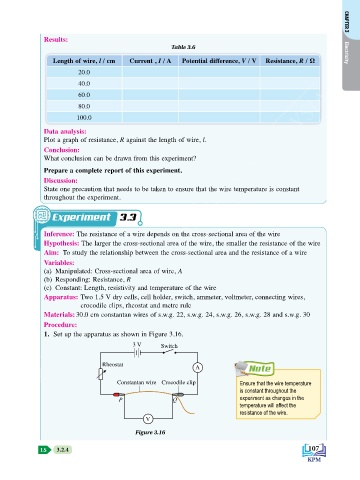
              1.  Set up the apparatus as shown in Figure 3.16.
                                         3 V     Switch


                                Rheostat
                                                            A               Note
                                    Constantan wire Crocodile clip       Ensure that the wire temperature
                                                                         is constant throughout the
                                                                         experiment as changes in the
                                     P               Q
                                                                         temperature will affect the
                                                                         resistance of the wire.
                                             V
                                          Figure 3.16


                                                                                              3.2.4
             LS     3.2.4                                                                     107

