


Page 118 - Physics Form 5 KSSM_Neat
P. 118
2.  Connect a 25 cm length of s.w.g. 22 constantan wire between P and Q.
             3.  Close the switch and adjust the rheostat until the current, I flowing in the circuit is 0.5 A.
             4.  Record the value of the potential difference across the wire.
             5.  Repeat steps 2 to 4 using the s.w.g. 24, s.w.g. 26, s.w.g. 28 and s.w.g. 30 constantan wires.

             6.  Based on the diameters given in Table 3.7, calculate the cross-sectional area of  wire, A = pr
                                                                                              2
                                 V
            KEMENTERIAN PENDIDIKAN MALAYSIA
                and resistance, R =   for the five sets of data obtained (r = wire radius).
                                 I
             7.  Record all the values for cross-sectional area, A, current, I, potential difference, V and
                resistance, R in Table 3.7.
             Results:
                                                   Table 3.7
                         Diameter,     Cross-sectional   Current,     Potential     Resistance,
               s.w.g.
                          d / mm        area, A / mm 2    I / A    difference, V / V   R / Ω

                22         0.711

                24         0.559
                26         0.457

                28         0.376

                30         0.315

             Data analysis:
             Plot a graph of resistance, R against cross-sectional area of wire, A.
             Conclusion:
             What conclusion can be drawn from this experiment?
             Prepare a complete report of this experiment.
             Discussion:
             State the relationship between:
             (a)  the cross-sectional area and the resistance of a wire.
             (b)  the value of s.w.g. and the resistance of a wire.


                                                                       R
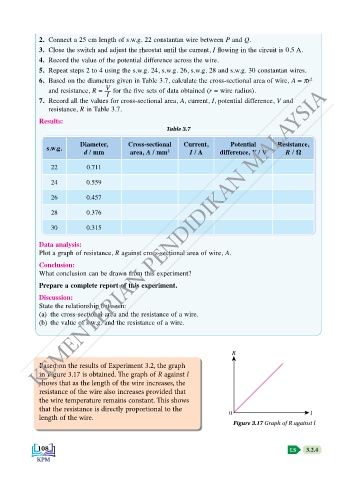
             Based on the results of Experiment 3.2, the graph
             in Figure 3.17 is obtained. The graph of R against l
             shows that as the length of the wire increases, the
             resistance of the wire also increases provided that
             the wire temperature remains constant. This shows
             that the resistance is directly proportional to the
             length of the wire.                                      0                       l
                                                                       Figure 3.17 Graph of R against l


            108                                                                         LS     3.2.4

