


Page 19 - Physics Form 5 KSSM_Neat
P. 19
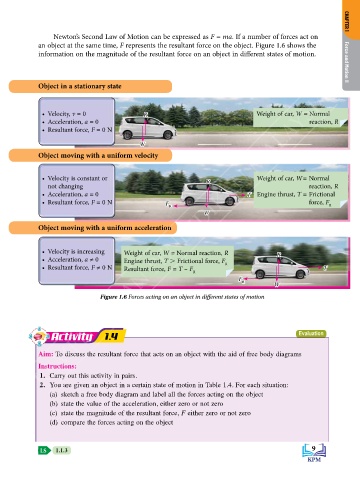
Newton’s Second Law of Motion can be expressed as F = ma. If a number of forces act on CHAPTER 1
an object at the same time, F represents the resultant force on the object. Figure 1.6 shows the
information on the magnitude of the resultant force on an object in different states of motion. Force and Motion II
Object in a stationary state
KEMENTERIAN PENDIDIKAN MALAYSIA
• Velocity, v = 0 R Weight of car, W = Normal
• Acceleration, a = 0 reaction, R
• Resultant force, F = 0 N
W
Object moving with a uniform velocity
• Velocity is constant or Weight of car, W = Normal
not changing R reaction, R
• Acceleration, a = 0 T Engine thrust, T = Frictional
• Resultant force, F = 0 N F force, F
R R
W
Object moving with a uniform acceleration
• Velocity is increasing Weight of car, W = Normal reaction, R
• Acceleration, a ≠ 0 Engine thrust, T Frictional force, F R
• Resultant force, F ≠ 0 N Resultant force, F = T – F R R T
F
R
W
Figure 1.6 Forces acting on an object in different states of motion
Activity 1.4 Evaluation
Aim: To discuss the resultant force that acts on an object with the aid of free body diagrams
Instructions:
1. Carry out this activity in pairs.
2. You are given an object in a certain state of motion in Table 1.4. For each situation:
(a) sketch a free body diagram and label all the forces acting on the object
(b) state the value of the acceleration, either zero or not zero
(c) state the magnitude of the resultant force, F either zero or not zero
(d) compare the forces acting on the object
LS 1.1.3 9

