


Page 191 - Physics Form 5 KSSM_Neat
P. 191
5.2   Semiconductor Diode                                                                   CHAPTER 5

             You have learnt that the transmission of electrical power to consumers through a network is in   Electronics
             the form of alternating current (A.C.). However, in everyday life, many electrical devices can
             only function with direct current (d.C.). Therefore, the alternating current has to be converted
             into a direct current. Photograph 5.1 shows a semiconductor diode which functions to convert
              KEMENTERIAN PENDIDIKAN MALAYSIA
             alternating current into direct current.


                                                                          Anode (+)   Cathode (–)


                                                                               Diode symbol
                                         Photograph 5.1 Semiconductor diode


                Activity        5.4


              Aim:  Discuss the function of a semiconductor diode
              Apparatus: Diode, dry cell, cell holder, bulb and connecting wires
              Instructions:
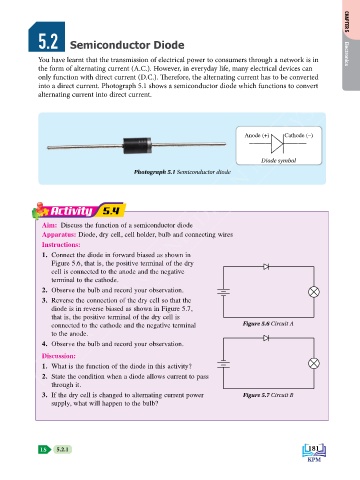
              1.  Connect the diode in forward biased as shown in
                Figure 5.6, that is, the positive terminal of the dry
                cell is connected to the anode and the negative
                terminal to the cathode.
              2.  Observe the bulb and record your observation.
              3.  Reverse the connection of the dry cell so that the
                diode is in reverse biased as shown in Figure 5.7,
                 that is, the positive terminal of the dry cell is
                connected to the cathode and the negative terminal        Figure 5.6 Circuit A
                to the anode.
              4.  Observe the bulb and record your observation.
              Discussion:
              1.  What is the function of the diode in this activity?
              2.  State the condition when a diode allows current to pass
                through it.
              3.  If the dry cell is changed to alternating current power   Figure 5.7 Circuit B
                supply, what will happen to the bulb?


                                                                                              5.2.1
             LS     5.2.1                                                                     181

