


Page 192 - Physics Form 5 KSSM_Neat
P. 192
The Function of a Semiconductor Diode
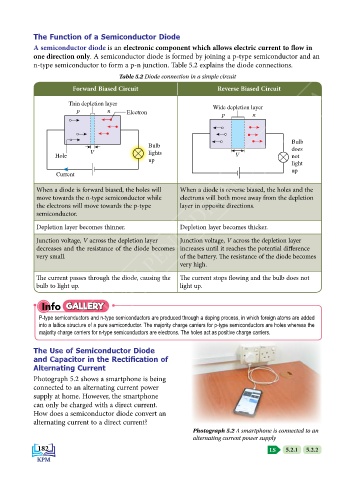
           A semiconductor diode is an electronic component which allows electric current to flow in
           one direction only. A semiconductor diode is formed by joining a p-type semiconductor and an
           n-type semiconductor to form a p-n junction. Table 5.2 explains the diode connections.

                                     Table 5.2 Diode connection in a simple circuit
                       Forward Biased Circuit                     Reverse Biased Circuit
            KEMENTERIAN PENDIDIKAN MALAYSIA
                      Thin depletion layer
                                                                 Wide depletion layer
                        p        n     Electron
                                                                    p        n


                                                                                         Bulb
                                              Bulb
                            V                 lights                                     does
                  Hole                                                  V                not
                                              up
                                                                                         light
                                                                                         up
                  Current
            When a diode is forward biased, the holes will   When a diode is reverse biased, the holes and the
            move towards the n-type semiconductor while   electrons will both move away from the depletion
            the electrons will move towards the p-type   layer in opposite directions.
            semiconductor.

            depletion layer becomes thinner.           depletion layer becomes thicker.
            Junction voltage, V across the depletion layer  Junction voltage, V across the depletion layer
            decreases and the resistance of the diode becomes  increases until it reaches the potential difference
            very small.                                of the battery. The resistance of the diode becomes
                                                       very high.
            The current passes through the diode, causing the   The current stops flowing and the bulb does not
            bulb to light up.                          light up.

              Info GALLERY

             P-type semiconductors and n-type semiconductors are produced through a doping process, in which foreign atoms are added
             into a lattice structure of a pure semiconductor. The majority charge carriers for p-type semiconductors are holes whereas the
             majority charge carriers for n-type semiconductors are electrons. The holes act as positive charge carriers.

           The Use of Semiconductor Diode
           and Capacitor in the Rectification of
           Alternating Current
           Photograph 5.2 shows a smartphone is being
           connected to an alternating current power
           supply at home. However, the smartphone
           can only be charged with a direct current.
           How does a semiconductor diode convert an
           alternating current to a direct current?
                                                           Photograph 5.2 A smartphone is connected to an
                                                           alternating current power supply
            182                                                                   LS     5.2.1     5.2.2

