


Page 197 - Physics Form 5 KSSM_Neat
P. 197
5.3   Transistor                                                               C            CHAPTER 5

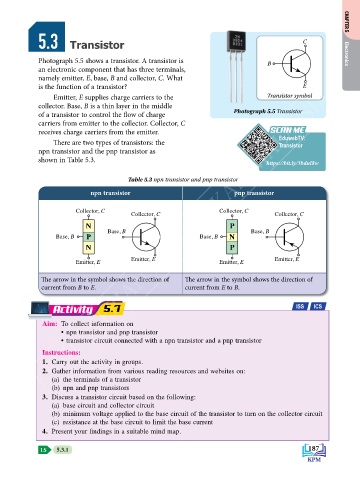
             Photograph 5.5 shows a transistor. A transistor is                  B                       Electronics
             an electronic component that has three terminals,
             namely emitter, E, base, B and collector, C. What
             is the function of a transistor?                                               E
              KEMENTERIAN PENDIDIKAN MALAYSIA
                 Emitter, E supplies charge carriers to the                      Transistor symbol
             collector. Base, B is a thin layer in the middle
             of a transistor to control the flow of charge             Photograph 5.5 Transistor
             carriers from emitter to the collector. Collector, C
                                                                                  SCAN ME
             receives charge carriers from the emitter.                           SCAN ME
                 There are two types of transistors: the                             EduwebTV:
                                                                                     Transistor
             npn transistor and the pnp transistor as
             shown in Table 5.3.                                                 https://bit.ly/3bdul8w


                                        Table 5.3 npn transistor and pnp transistor
                            npn transistor                             pnp transistor


                        Collector, C                               Collector, C
                                        Collector, C                               Collector, C
                           N                                          P
                                 Base, B                                    Base, B
                  Base, B  P                                 Base, B  N
                           N                                          P
                                        Emitter, E                                 Emitter, E
                        Emitter, E                                 Emitter, E

             The arrow in the symbol shows the direction of   The arrow in the symbol shows the direction of
             current from B to E.                        current from E to B.


                 Activity       5.7                                                       ISS  ICS

              Aim:  To collect information on
                   • npn transistor and pnp transistor
                   • transistor circuit connected with a npn transistor and a pnp transistor

              Instructions:
              1.  Carry out the activity in groups.
              2.  Gather information from various reading resources and websites on:
                 (a)  the terminals of a transistor
                 (b)  npn and pnp transistors
              3.  Discuss a transistor circuit based on the following:
                 (a)  base circuit and collector circuit
                 (b)  minimum voltage applied to the base circuit of the transistor to turn on the collector circuit
                 (c)  resistance at the base circuit to limit the base current
              4.  Present your findings in a suitable mind map.


                                                                                              5.3.1
             LS     5.3.1                                                                     187

